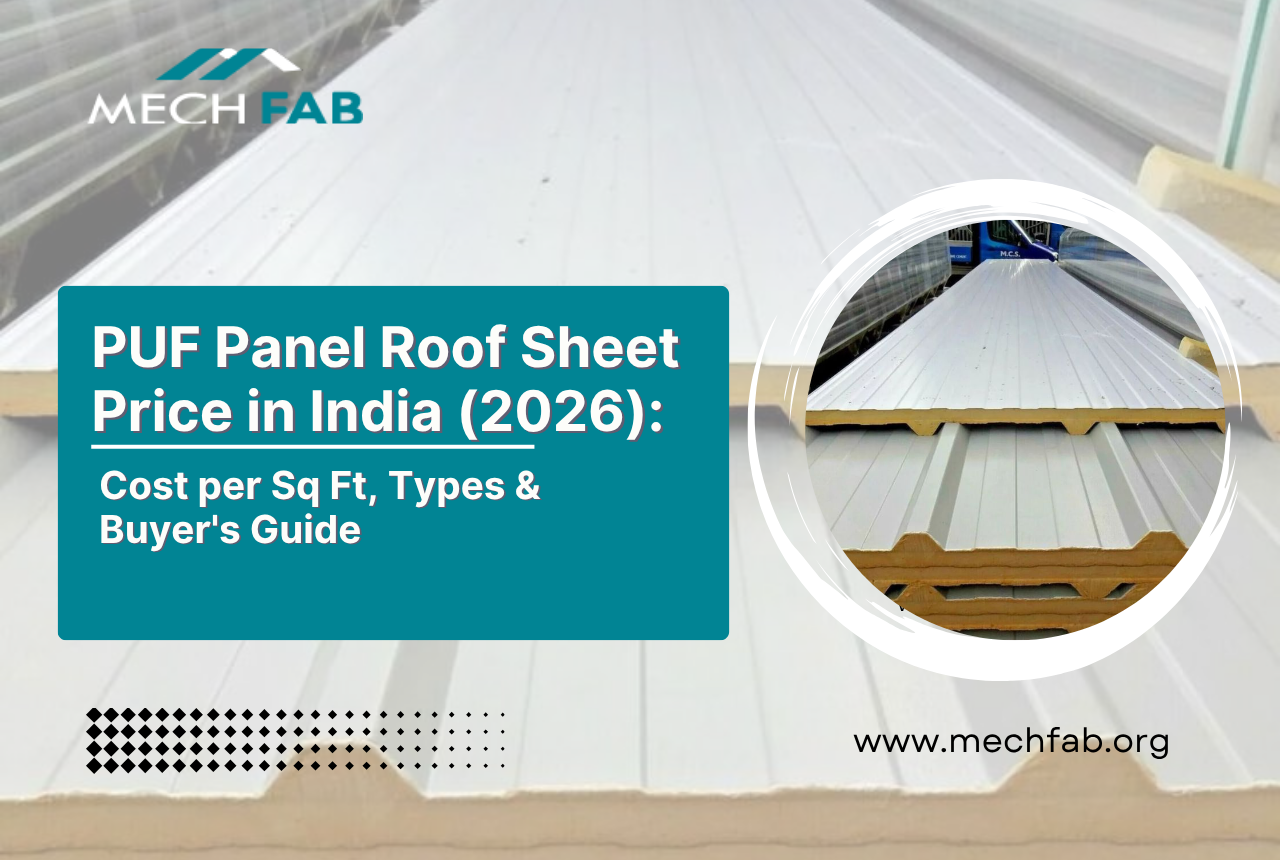
If you are planning a new factory shed, warehouse, cold storage unit, or any pre-engineered building, one of the first questions you will ask is simple: what is the PUF panel roof sheet price? The honest answer is that there is no single price — the rate depends on thickness, foam density, steel quality, order size, and how far the panels have to travel. This guide breaks down the 2026 price range in plain terms, explains what a PUF panel is actually made of, and shows you how to compare quotes like a professional buyer.
PUF Panel Roof Sheet Price List (2026)
Use the chart below as a starting reference. These are indicative ex-factory ranges for standard sandwich roofing panels with pre-painted galvanised steel skins. Actual project rates depend on the exact specification and your site location.
| Panel Thickness | Indicative Roof Price (₹/sq ft)* | Typical Use |
|---|---|---|
| 10 mm (cool-roof single skin) | ₹65 – ₹80 | Sheds, canopies, re-roofing over old tin |
| 30 mm | ₹100 – ₹120 | Warehouses, factory sheds, showrooms |
| 40 mm | ₹110 – ₹135 | Industrial roofing, general commercial |
| 50 mm | ₹120 – ₹150 | Most popular — sheds, cold rooms, offices |
| 60 mm | ₹127 – ₹165 | Higher insulation, food & pharma units |
| 80 mm | ₹145 – ₹210 | Cold storage, chillers, clean rooms |
| 100 mm+ | ₹200 – ₹380 | Deep-freeze, ammonia plants, FM-rated jobs |
What Is a PUF Panel Made Of?
PUF stands for Poly-Urethane Foam. A PUF roof panel is a sandwich panel — a rigid insulating foam core locked between two thin metal sheets. This three-layer construction is what gives the panel its light weight, strength, and excellent thermal insulation in a single product.
The three core components
- Rigid polyurethane foam core — formed by a chemical reaction between polyol and isocyanate. It expands into a closed-cell foam with very low thermal conductivity. A density of 40 kg/m³ is the trusted industry standard, with core thickness usually between 30 mm and 150 mm.
- Two metal face sheets — typically 0.40–0.60 mm pre-painted galvanised iron (PPGI). For corrosive or hygienic environments, stainless steel or aluminium skins are used. These faces carry the structural load and protect the foam.
- Interlocking edge joint — a tongue-and-groove or cam-lock profile along the edges that lets panels snap together into a continuous, leak-proof, thermally sealed surface.
The result is a roofing sheet that keeps interiors cooler in summer and warmer in winter, cuts air-conditioning costs, resists leaks, and installs far faster than traditional roofing.
What Affects the Price of a PUF Roof Sheet?
Two panels can look identical yet be priced very differently. Before you compare quotes, understand the seven levers that move the rate:
| Price Factor | How It Moves the Rate |
|---|---|
| Panel thickness / core depth | Every extra 10 mm of foam adds roughly ₹15–₹25 per sq ft. |
| Foam core density | 40 kg/m³ is the trusted standard; 36 kg/m³ is cheaper but weaker and less fire-safe. |
| Steel skin & coating | 0.50 mm PPGI is standard; 0.60 mm or SS 304 skins can add 20–50% for corrosion-prone sites. |
| Roof vs wall profile | Trapezoidal roof panels run 6–10% higher than wall panels of the same thickness. |
| Order quantity | A 50,000 sq ft order can cost 10–15% less per sq ft than a 2,000 sq ft one. |
| Freight to site | Delivery to remote Northeast India can add ₹10–₹25 per sq ft from far-off plants. |
| GST | 18% GST is almost always charged over and above the quoted rate. |
Panel price is not the same as installed cost
A common mistake is comparing bare panel rates alone. The panel itself is usually only 55–70% of the finished roof cost. The rest comes from accessories (flashing, sealants, screws, ridge and gutter), freight, and erection labour. When you budget, plan for the complete installed price, not just the sheet.
PUF Roof Panels vs Wall Panels
Roofing panels are engineered differently from wall panels. A roof must handle rainfall, wind uplift, standing-water load, and constant sun exposure, so roof profiles are deeper (usually trapezoidal) and the outer skin is specified for higher weather resistance. That extra engineering is why a PUF roof sheet costs 6–10% more per sq ft than a wall panel of the same thickness. When you request pricing, always specify that you need roofing panels so the quote reflects the correct profile.
PUF Panel Manufacturers in India: How to Choose the Right One
India has a large and growing base of PUF panel manufacturers, concentrated in Gujarat, Maharashtra, Karnataka, and the industrial belts of each region. Prices are usually most competitive close to a manufacturing hub, because freight to distant sites adds real cost. For projects in Northeast India, sourcing from a regional manufacturer avoids the ₹10–₹25 per sq ft freight penalty that comes with shipping panels across the country.
When you shortlist PUF panel manufacturers in India, check these before you sign:
- Clearly stated foam density (insist on 40 kg/m³) and steel skin thickness.
- Continuous sandwich-panel production line for consistent bonding and quality.
- Proven track record and references in your building type — sheds, cold storage, or PEB.
- In-house design, manufacturing, and erection so accountability stays with one partner.
- Proximity to your site to control freight cost and delivery time.
Why Buy PUF Roofing Panels from MECHFAB
MECHFAB Engineering Industries Pvt. Ltd. is a leading steel fabrication and pre-engineered building (PEB) manufacturer based in Guwahati, Assam, with a legacy dating back to 1978. For over four decades we have designed, manufactured, and erected durable steel buildings and roofing solutions across Northeast India.
- Regional advantage: based in Guwahati, we cut the freight cost and delays that come with sourcing panels from distant states.
- Four decades of expertise: a trusted PEB and steel partner since 1978, with deep experience in the Northeast’s climate and terrain.
- End-to-end delivery: design, fabrication, and on-site erection under one roof for industrial, commercial, and infrastructure projects.
- Customised, cost-effective solutions: roofing and building specifications matched to your budget, use case, and site conditions.
Where PUF Roof Panels Are Used
PUF roofing sheets are the go-to insulated roofing solution across a wide range of buildings:
- Industrial factory sheds and manufacturing units
- Warehouses and logistics or distribution centres
- Cold storage, chillers, and deep-freeze rooms
- Food processing, dairy, and pharmaceutical facilities
- Showrooms, commercial buildings, and offices
- Poultry sheds, cattle sheds, and agricultural structures
Frequently Asked Questions
What is the price of a PUF panel roof sheet in India?
In 2026, PUF roof sheet prices in India range from about ₹65 per sq ft for a thin 10 mm cool-roof panel to ₹380 per sq ft for heavy 100 mm+ cold-storage grade panels. The popular 50 mm panel costs roughly ₹120–₹150 per sq ft, ex-factory and excluding GST.
What is a PUF panel made of?
A PUF panel is made of a rigid polyurethane foam core sandwiched between two thin pre-painted metal sheets, with an interlocking tongue-and-groove or cam-lock edge. The foam gives insulation while the steel skins provide strength and weather protection.
Which thickness of PUF roof panel is best?
For most factory sheds, warehouses, and commercial roofs, a 50 mm panel offers the best balance of insulation and cost. Cold storage and temperature-controlled units typically need 80 mm to 150 mm for higher thermal performance.
Is GST included in PUF panel prices?
Usually not. Most manufacturers quote ex-factory rates with 18% GST charged separately, along with freight and installation. Always confirm what a quote includes before comparing.
Are PUF roof panels good for the Northeast India climate?
Yes. PUF panels resist heat, heavy rain, and humidity, keeping interiors cooler and drier. Sourcing from a regional manufacturer like MECHFAB in Guwahati also reduces freight cost and delivery time for Northeast projects.