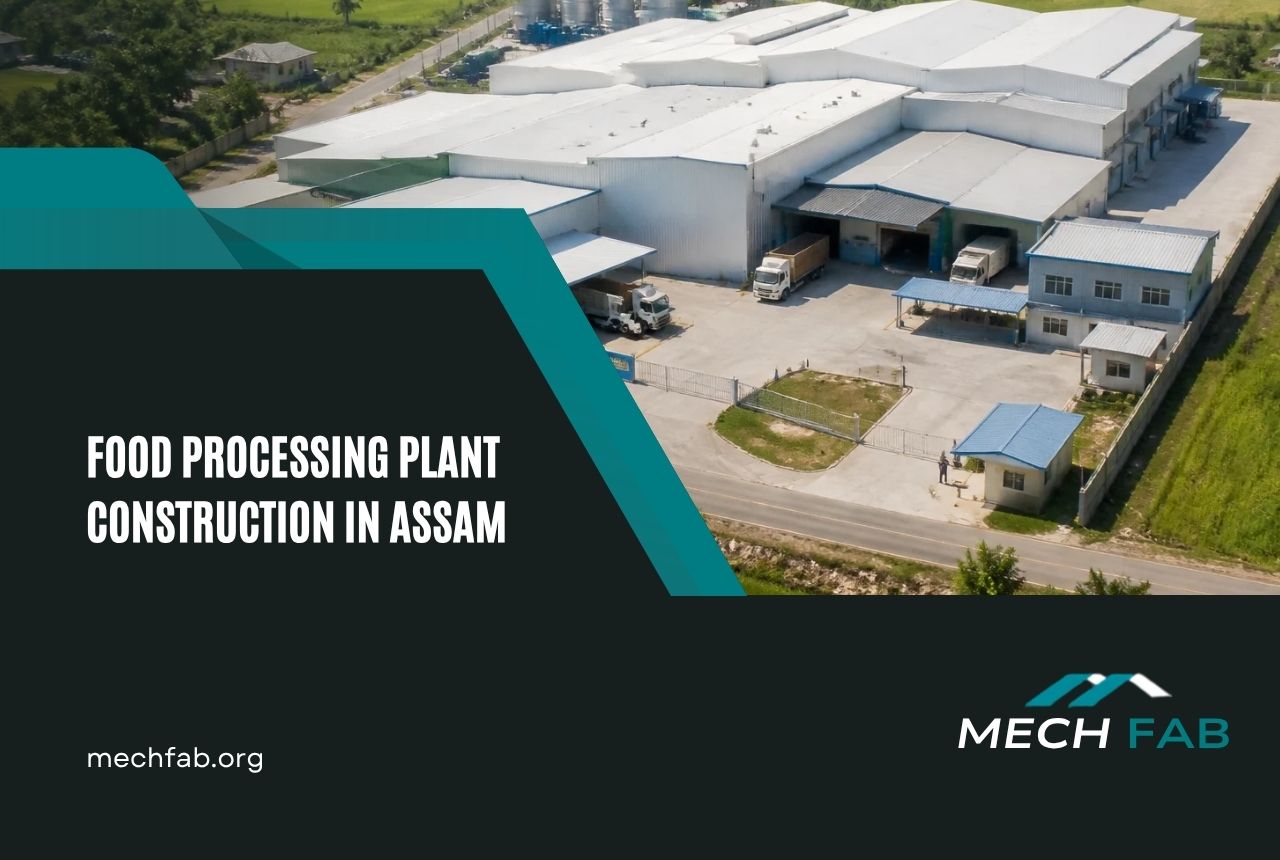
Food Processing Plant Construction in Assam is becoming increasingly relevant as the state expands its food-processing, agricultural, logistics and cold-chain ecosystem.
Assam has a diverse agricultural base and opportunities across food processing, sourcing, logistics and cold chains. The Government of Assam identifies food processing as a sector with growth potential and highlights the need for additional processing infrastructure.
But establishing a food-processing unit requires much more than constructing a conventional industrial shed.
The building must support:
- Raw-material receiving
- Processing
- Hygiene
- Storage
- Packaging
- Utilities
- Temperature control
- Employee movement
- Dispatch
- Future expansion
Whether you are planning a spice-processing unit, fruit-processing facility, packaged-food factory, dairy-related facility, agro-processing unit or food warehouse, this guide explains 9 important factors to consider before starting Food Processing Plant Construction in Assam.
Quick Answer: A food processing plant in Assam should be designed around production flow, hygiene zoning, drainage, structural requirements, roofing and insulation, cold storage, utilities, logistics and future expansion. Pre-engineered steel buildings can be particularly useful where large spans, fast construction and flexible expansion are required.
Table of Contents
- Why Food Processing Is a Growth Opportunity in Assam
- Choose the Right Location
- Start with the Production Process
- Create Proper Hygiene Zones
- Choose the Right Building Structure
- Plan Flooring and Drainage
- Design Roofing, Insulation and Ventilation
- Integrate Cold Storage Where Required
- Plan Utilities Properly
- Design Loading and Logistics Areas
- Plan for Future Expansion
- PEB vs Conventional Construction
- Food Processing Plant Cost Factors
- Construction Checklist
- Why Regional Experience Matters
- FAQs
Why Food Processing Plant Construction in Assam Has Growth Potential
Assam has several characteristics that support greater food-processing activity.
The Government of Assam highlights favourable agro-climatic conditions, demand for processed foods and opportunities in:
- Processing
- Sourcing
- Logistics
- Cold chains
The state’s industrial-development ecosystem also includes food-processing infrastructure such as the Mega Food Park at Nathkuchi, Tihu in Nalbari. Government information lists facilities including warehouse infrastructure, standard-design factory space, cold storage, internal roads, drainage, power infrastructure and food-testing facilities.
This creates opportunities not only for large food manufacturers but also for:
Agro-processing businesses
Spice processors
Fruit and vegetable processors
Packaged-food manufacturers
Cold-chain operators
Warehousing businesses
FMCG manufacturers
Export-oriented food businesses
For construction companies, this also creates growing demand for specialised industrial buildings rather than conventional commercial construction.
1. Choose the Right Location for a Food Processing Plant in Assam
Location affects nearly every part of a food-processing business.
Before purchasing industrial land, consider where your raw materials, labour and customers are located.
Raw Material Proximity
If your plant processes agricultural produce, locating reasonably close to sourcing areas can reduce transport time and handling.
This can become especially important for perishable products.
Highway Connectivity
Processed products still need to reach wholesalers, retailers, warehouses and other states.
Check access to:
- National highways
- Major roads
- Railway connectivity
- Distribution centres
- Logistics hubs
Utilities
Confirm the availability and capacity of:
- Electricity
- Water
- Drainage
- Telecommunications
- Backup power options
Land for Expansion
Don’t calculate land requirements using only the proposed factory footprint.
A food-processing facility may also require:
Factory + Warehouse + Cold Storage + Utilities + Roads + Parking + Waste Management + Expansion
Buying a site that barely accommodates the first phase can create expensive limitations later.
2. Start Food Processing Plant Design with the Production Process
One of the most important principles in Food Processing Plant Construction in Assam is this:
Don’t design the building first and force the production process inside it later.
Map the process first.
For example:
Raw Material Receiving → Inspection → Cleaning → Processing → Quality Control → Packaging → Finished Goods Storage → Dispatch
Every food business will have a different flow.
A spice-processing plant might require:
Raw spices → Cleaning → Drying → Grinding → Blending → Packaging
A fruit-processing facility might require:
Receiving → Washing → Sorting → Processing → Packaging → Cold Storage
These processes affect:
- Room positioning
- Building dimensions
- Equipment layout
- Floor requirements
- Utilities
- Ventilation
- drainage
- Material movement
A good factory layout reduces unnecessary movement and helps separate different stages of production.
3. Create Proper Hygiene and Process Zones
Food factories require much more attention to zoning than ordinary industrial sheds.
Depending on the product, different parts of the factory may need to be separated into areas such as:
Raw Material Zone
Where incoming materials are received and inspected.
Processing Zone
Where the primary manufacturing operation occurs.
Packaging Zone
Where finished products are packed.
Finished Goods Zone
Where products wait for dispatch.
Utility Zone
For electrical systems, equipment and support services.
Employee Areas
Changing rooms, washrooms and staff facilities should be positioned so movement does not interfere unnecessarily with production areas.
The exact requirements depend on the food product and applicable regulatory standards.
The important building principle is to create a logical and controlled movement of people and materials.
Poor zoning can cause operational inefficiency even when the building itself is structurally excellent.
4. Choose the Right Structure for a Food Processing Factory
Many modern food-processing facilities can benefit from Pre-Engineered Building (PEB) construction.
PEB structures are engineered and largely fabricated in controlled factory conditions before components are transported to site for erection.
Potential advantages include:
- Large clear spans
- Faster construction
- Flexible factory layouts
- Reduced internal columns
- Easier future expansion
- Factory-controlled fabrication
- Compatibility with insulated panel systems
For businesses unfamiliar with this construction system, MechFab’s Pre-Engineered Steel Buildings guide explains its structure, applications and benefits.
Why Clear Span Matters in Food Processing
Internal columns can interfere with:
- Production lines
- Conveyors
- Machinery
- Material movement
- Packaging systems
Larger clear-span areas can therefore make production layouts more flexible.
However, the optimum span should be engineered around the production requirement rather than automatically choosing the largest possible span.
For technical planning, see MechFab’s Pre-Engineered Buildings Design guide.
5. Plan Food-Factory Flooring and Drainage Carefully
Flooring is particularly important in a food-processing plant.
Depending on operations, the floor may face:
- Water
- Cleaning chemicals
- Heavy machinery
- Trolleys
- Forklifts
- Food residue
- Frequent washing
- Temperature changes
The flooring system should therefore be selected according to the production process.
Drainage Is Equally Important
Wet-processing areas may require carefully designed floor slopes and drains.
Water should move toward designated drainage points rather than accumulate around equipment.
In Assam, site drainage also matters because of regional rainfall.
Factory drainage therefore needs to address both:
Internal process water
and
External stormwater
The plant floor, plinth and surrounding site drainage should be coordinated from the beginning.
6. Design Roofing, Insulation and Ventilation for Assam
Assam’s rainfall, humidity and warm conditions make the building envelope an important design decision.
Roof design may need to consider:
- Heavy rainfall
- Heat gain
- Condensation
- Insulation
- Corrosion protection
- Gutters
- Downpipes
- Ventilation
Insulated Roof and Wall Panels
Certain processing areas may benefit from insulated sandwich panels.
PUF panels can provide thermal insulation and can be used in selected industrial, warehouse and cold-storage applications.
MechFab’s PUF Panel Roof Sheet Price in India guide explains panel types, thickness and pricing considerations.
Businesses comparing suppliers can also read Top 10 PUF Panel Manufacturers in India.
Ventilation
Different production processes generate different levels of:
- Heat
- Steam
- Moisture
- Odour
- Airborne particles
Ventilation requirements should therefore be designed around the actual process.
Possible solutions can include:
- Ridge ventilators
- Louvers
- Exhaust systems
- Mechanical ventilation
- Air-handling systems
Don’t specify ventilation using a generic industrial-shed template.
7. Integrate Cold Storage from the Beginning
Some food-processing plants require temperature-controlled storage.
Examples can include:
- Fruits
- Vegetables
- Dairy products
- Frozen food
- Meat and seafood
- Certain packaged products
Cold storage should not be treated as an ordinary room where refrigeration equipment is added later.
The building envelope, panels, floor, doors, refrigeration equipment and vapour control need to work together.
MechFab’s Cold Storage Construction Companies in India guide explains why cold-store construction requires coordination between the structure, insulation and refrigeration systems.
That article should be a strong internal link from this section because a visitor planning a food factory with cold storage has clear commercial intent.
Do You Actually Need Cold Storage?
Not every food-processing factory needs it.
Determine:
- Required storage temperature
- Raw-material shelf life
- Finished-product storage
- Daily processing volume
- Dispatch frequency
Cold-storage capacity should be based on operational requirements rather than guesswork.
8. Plan Utilities Before Finalising the Building
A food-processing factory can require significantly more utilities than a simple warehouse.
Depending on the plant, these may include:
- Electrical supply
- Backup power
- Water
- Steam
- Compressed air
- Refrigeration
- HVAC
- Effluent systems
- Fire protection
- Processing equipment
- Lighting
Utility routes should be coordinated with:
Structure + Machinery + Maintenance Access
For example, adding major service lines after the steel structure and production layout are already finalised can lead to avoidable modifications.
Provide the structural and building-design teams with major equipment information early in the project.
9. Design Loading, Storage and Logistics Around Real Operations
Food plants usually involve continuous movement between suppliers, factory operations and distribution.
Your site plan should therefore include:
- Raw-material unloading
- Finished-goods loading
- Truck turning
- Parking
- Warehouse access
- Cold-storage access
- Worker movement
Where practical, raw materials and finished goods should have logical movement routes.
If the plant requires significant warehousing, read MechFab’s Types of Warehouses guide to understand the differences between general warehouses, distribution centres, cold storage and other storage formats.
For budgeting, MechFab’s PEB Warehouse Construction Cost guide explains the major cost factors involved in warehouse development.
Food Processing and Cold-Chain Opportunities in Assam
Cold-chain infrastructure is particularly relevant to Assam’s food-processing opportunity.
Government industrial information specifically identifies opportunities in logistics and cold chains alongside food processing.
That connection creates several related project opportunities:
Processing Unit
↓
Temperature-Controlled Storage
↓
Warehouse
↓
Distribution
↓
Retail/Export
For companies operating across this chain, it may make more sense to plan these facilities as part of one industrial master plan rather than building them independently over several years.
Food Processing Infrastructure Around Guwahati and Assam
Assam already has industrial areas and sector-specific infrastructure across several districts.
Government information lists industrial infrastructure at locations including:
- Amingaon
- Chaygaon
- Tihu
- Bongaigaon
- Nalbari
- Other industrial areas across the state
The Tihu/Nathkuchi Mega Food Park is particularly relevant because its infrastructure planning includes food-processing units, warehousing, cold storage and food-testing facilities.
This doesn’t mean every food manufacturer should locate inside a food park.
The correct site depends on:
Raw Materials + Customers + Roads + Utilities + Land + Logistics
PEB vs RCC for Food Processing Plant Construction in Assam
Which construction method should be used?
Both can be appropriate depending on the facility.
| Factor | PEB Factory | RCC Factory |
|---|---|---|
| Main structural system | Steel | Reinforced concrete |
| Construction approach | Factory fabrication + erection | Primarily site-based |
| Large clear spans | Excellent | Project dependent |
| Construction speed | Generally faster | Generally more site-intensive |
| Future expansion | Often easier to plan | Possible but may be more disruptive |
| Structural weight | Relatively lighter | Heavier |
| Equipment layout flexibility | High | Design dependent |
| Insulated panel integration | Straightforward | Possible |
The correct decision should consider the entire building rather than just initial structure cost.
MechFab’s PEB vs RCC guide provides a deeper comparison.
How Much Does a Food Processing Plant Building Cost in Assam?
There is no reliable universal cost-per-square-foot number for every food factory.
A simple dry-processing building and a temperature-controlled food factory are completely different projects.
Cost can depend on:
Building Area
Larger plants require more structure, roofing and civil work.
Height and Span
Building dimensions affect steel requirements.
Structural Loads
Machinery, mezzanines and other systems can influence structural design.
Flooring
Food-grade or specialised industrial flooring can increase costs.
Insulation
PUF or other insulated systems add cost compared with basic cladding.
Cold Storage
Refrigeration and specialised building-envelope requirements significantly change the project.
Utilities
Processing plants can require substantial mechanical and electrical infrastructure.
Drainage
Process drainage and site drainage need proper planning.
Location
Transportation and site accessibility also affect costs.
For the steel-building portion, MechFab’s Pre-Engineered Steel Building Cost Per Square Foot guide explains how span, height, steel quantity, location and specifications affect PEB pricing.
A serious food-processing project should therefore be budgeted using:
Process Requirement → Layout → Engineering → BOQ → Project Cost
rather than starting with a generic rate per square foot.
Food Processing Plant Construction Checklist
Before approaching a construction company, prepare:
✓ Type of food product
✓ Expected production capacity
✓ Raw-material requirements
✓ Process flow
✓ Machinery list
✓ Approximate building area
✓ Clear-height requirement
✓ Storage requirement
✓ Cold-storage requirement
✓ Warehouse requirement
✓ Flooring requirement
✓ Drainage requirement
✓ Electrical requirement
✓ Water requirement
✓ Ventilation/HVAC requirement
✓ Loading and dispatch requirements
✓ Future expansion plan
The more accurately these requirements are defined, the more useful your construction proposal will be.
Choosing a Food Processing Plant Construction Company in Assam
The lowest construction quote should not automatically win.
Evaluate the contractor on:
Industrial Project Experience
Has the company built actual production facilities?
Regional Experience
Assam brings specific considerations related to rainfall, humidity, logistics and seismic engineering.
PEB Engineering Capability
If you’re using PEB, evaluate design and structural-engineering capability — not just fabrication.
Fabrication Infrastructure
Understand where structural components will be manufactured.
Erection Capability
Factory fabrication and site erection should work as one system.
Completed Projects
Look for real industrial projects rather than relying only on marketing claims.
MechFab’s project portfolio is particularly relevant here because it includes warehouses, industrial buildings and a spice-processing unit at Kaliabor, Nagaon for Amalgamated Plantations Pvt. Ltd. (TATA).
For a broader supplier-evaluation framework, read Pre Engineered Buildings Companies in India.
Food Processing Plant Construction in Assam with MechFab
MechFab Engineering Industries Pvt. Ltd. is based in Guwahati and has worked in steel fabrication and construction since 1978. Its published portfolio includes warehouses, manufacturing buildings, industrial structures and a spice-processing project in Assam.
That regional project experience is particularly relevant for food manufacturers looking at construction in Assam and Northeast India.
A PEB food-processing project can involve:
Requirement Analysis
↓
Factory Layout Coordination
↓
Structural Engineering
↓
Fabrication
↓
Transportation
↓
Erection
↓
Future Expansion
Businesses planning a new processing unit can first review MechFab’s Projects to see completed industrial work.
For project-specific discussions, Contact MechFab with information about your location, building dimensions, production process and estimated future capacity.
MechFab’s contact page identifies the company as a PEB manufacturer based in Guwahati, Assam.
Frequently Asked Questions
Is food processing a growing industry in Assam?
The Government of Assam identifies food processing as a sector with growth potential and highlights opportunities in processing, sourcing, logistics and cold chains.
What is required for Food Processing Plant Construction in Assam?
Requirements depend on the product but commonly include production areas, storage, utilities, drainage, ventilation, hygiene zoning, loading facilities and potentially cold storage.
Is PEB suitable for food processing plants?
PEB can be suitable for many food-processing factories because it provides flexible spans, relatively rapid construction and the ability to integrate industrial roofing and insulated-panel systems.
Read Pre-Engineered Steel Buildings for more information.
Does every food-processing factory need cold storage?
No. Cold-storage requirements depend on the raw material, process, finished product and required storage temperature.
If temperature-controlled storage is required, read Cold Storage Construction Companies in India before planning the facility.
How much does a food-processing factory cost to build?
Cost depends on building size, structural system, machinery, flooring, utilities, insulation, cold storage, drainage and location. A process-specific BOQ provides a more meaningful estimate than a generic per-square-foot rate.
Where can a food-processing unit be established in Assam?
The right location depends on raw materials, logistics, utilities and customer markets. Assam has several industrial areas and food-processing-related infrastructure, including the Tihu/Nathkuchi Mega Food Park.
What type of roofing is suitable for a food factory?
The correct system depends on temperature, humidity, process conditions and insulation requirements. Some facilities may use profiled roofing while others require insulated panels.
See PUF Panel Roof Sheet Price in India for more information about insulated roofing.
Can a food-processing plant include its own warehouse?
Yes. Many processing facilities integrate raw-material storage and finished-goods warehouses.
Read Types of Warehouses to understand different storage models.
Can a food-processing PEB factory be expanded later?
Yes. Future extensions can often be incorporated into PEB planning. Expansion direction, available land and utility capacity should be considered in the first phase.
Does MechFab have experience with food-processing infrastructure?
MechFab’s published project portfolio includes a spice-processing unit at Kaliabor, Nagaon for Amalgamated Plantations Pvt. Ltd. (TATA), alongside warehouse and manufacturing projects.
Final Takeaway
The opportunity around Food Processing Plant Construction in Assam goes beyond building another industrial shed.
Assam’s agricultural base, growing demand for processed food, cold-chain requirements and food-processing infrastructure create opportunities for businesses that plan facilities intelligently.
Before construction:
Start with the production process.
Choose the site around raw materials and logistics.
Design hygiene zones properly.
Plan floors and drainage around actual operations.
Integrate cold storage where required.
Engineer roofing and ventilation for Assam’s conditions.
Coordinate machinery and utilities before structural design is frozen.
And reserve space for future growth.
For investors and food manufacturers, the building should not simply house today’s operation.
It should be engineered to support the next stage of the business.
Explore MechFab’s completed industrial projects or contact MechFab to discuss a food-processing, warehouse, cold-storage or PEB project in Assam.