Imagine you are planning a new warehouse in Guwahati or a factory shed in Assam. You receive a quote, sign the contract, and halfway through construction the bills start climbing past your budget. Sound familiar? This is the single biggest pain point for anyone investing in industrial or commercial construction in Northeast India today.
The pre engineered steel building cost per square foot is not a fixed number. It changes based on your design, location, steel grade, fabrication quality, and a dozen other variables. In 2026, with steel prices stabilising after post-pandemic volatility, buyers finally have a clearer picture — but only if they know what to look for.
This guide breaks down everything: what drives the price, realistic cost ranges in India, how Guwahati and Assam-specific factors affect your quote, and how to get the best value without cutting corners.
What Is a Pre Engineered Steel Building (PEB)?
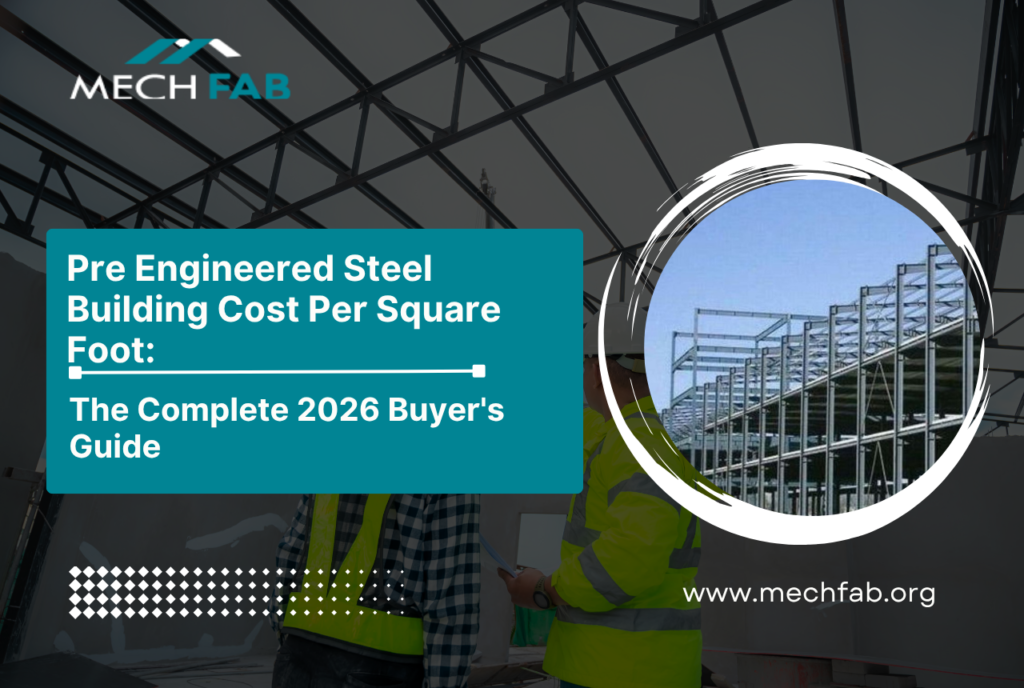
A Pre Engineered Steel Building (PEB) is a complete structural steel system designed, fabricated, and delivered by a manufacturer — ready to assemble on-site. Unlike conventional construction where every component is specified separately, PEB systems are engineered as an integrated package: primary frames, secondary framing, roofing, wall cladding, doors, and accessories.
The biggest advantage? Speed. A conventional RCC factory might take 18 months to build. An equivalent PEB structure can be up in 4-6 months.
Key Components of a PEB System
- Primary Steel Frames (Tapered I-sections or straight columns/rafters)
- Secondary Framing (Purlins, girts, eave struts)
- Roof & Wall Cladding (Single skin, insulated sandwich panels, or color-coated sheets)
- Fasteners, anchor bolts, and mezzanine floors (if required)
- Doors, windows, skylights, and ventilators
- Foundation design data (Civil work is separate and extra)
Pre Engineered Steel Building Cost Per Square Foot in 2026
The table below gives realistic cost ranges for common PEB building types in India. These include supply and erection of the steel structure and cladding only. Civil foundation work, electrical, plumbing, and interior fit-outs are additional.
| Building Type | Span Range | Cost (INR/sq ft) | Cost (USD/sq ft approx.) |
| Simple Warehouse / Godown | 18m – 30m | INR 800 – 1,100 | USD 9.50 – 13.00 |
| Industrial Factory Shed | 24m – 40m | INR 1,000 – 1,400 | USD 12.00 – 17.00 |
| Insulated Cold Store / Clean Room | 12m – 24m | INR 1,400 – 1,900 | USD 17.00 – 23.00 |
| Multi-Storey PEB (Mezzanine) | 15m – 30m | INR 1,500 – 2,000 | USD 18.00 – 24.00 |
| Aircraft Hangar / Large Clear Span | 40m – 80m+ | INR 1,800 – 2,500+ | USD 22.00 – 30.00+ |
| Commercial / Retail Showroom | 12m – 24m | INR 1,300 – 2,200 | USD 16.00 – 26.00 |
Note: 1 sq ft = 0.0929 sq m. Prices are indicative for 2026 and may vary ±15% based on project specifics and market conditions.
Northeast India / Guwahati Premium
Assam and Northeast India attract a logistics surcharge of roughly 8-15% above pan-India prices. This is due to transportation distance from major steel mills (Rourkela, Jamshedpur, Bhilai), road/rail connectivity constraints, and limited local fabrication competition.
For example, a warehouse project quoted at INR 950/sq ft in Pune might cost INR 1,050-1,100/sq ft in Guwahati after accounting for freight and local erection costs.
7 Key Factors That Drive Your PEB Cost Per Square Foot
1. Steel Price Index (Primary Driver)
Hot-rolled structural steel (IS 2062 Grade) drives 50-60% of total PEB cost. In 2026, domestic HR coil prices have settled in the INR 55,000-62,000/tonne range. Projects quoted when steel was at INR 70,000/tonne (2022 peak) cost 15-20% more. Always ask your vendor for a material cost lock-in or escalation clause.
2. Building Span and Height
Wider clear spans require heavier tapered sections with more steel tonnage per square foot. A 20m span warehouse needs roughly 12-16 kg of steel per sq ft. A 50m clear-span hangar may need 22-28 kg/sq ft. Height also matters — a 12m eave height costs more than a 6m eave for the same footprint.
3. Wind and Seismic Zone
Assam sits in Seismic Zone V, the highest risk category in India. This means heavier column sections, stronger connections, and more anchor bolts — all adding 8-12% to structural cost compared to a Zone II project. Similarly, cyclone-prone zones require higher wind load design.
4. Roof and Wall Cladding Type
- Single-skin colour-coated GP sheets: Lowest cost (INR 90-130/sq ft for supply)
- Insulated sandwich panels (PIR/PUF core): Premium option (INR 350-600/sq ft)
- Tile-profile cladding for aesthetics: Medium-high (INR 180-280/sq ft)
For cold storage, pharmaceutical, or food processing facilities in Guwahati, insulated panels are mandatory — budget accordingly.
5. Foundation and Civil Work (Often Overlooked)
Civil foundation work — earth excavation, PCC, RCC footings, plinth beams, and floor slab — typically adds INR 200-450/sq ft over and above the PEB steel structure cost. Many buyers are shocked when the civil contractor’s quote arrives. Always plan your total budget including civil.
6. Mezzanine Floors and Internal Features
Adding a mezzanine level for office space, storage, or production adds INR 350-600/sq ft for the mezzanine area. Other cost-adders include overhead cranes (EOT or HOT), fire protection systems, false ceilings, and HVAC ducting provisions in the structure.
7. Fabricator Quality and Certifications
An IS 800:2007-compliant fabricator with BIS certification and in-house shot blasting + painting will cost 10-18% more than a local shop fabricator. But the quality difference is critical for long-term performance, especially in Assam’s humid climate. Always check fabricator credentials, project portfolio, and quality plan before comparing prices on cost per square foot alone.
How to Estimate Your PEB Project Cost: Step-by-Step
- Define your building dimensions: Length x Width x Eave Height
- Identify occupancy and loading: storage, manufacturing, offices, crane loads
- Determine cladding type: open sides, single skin, insulated panels
- Check seismic and wind zone for your location (mandatory for structural design)
- Get at least 3 quotations from PEB fabricators with detailed BOQ (Bill of Quantities)
- Add civil foundation cost (get separate quote from civil contractor)
- Add logistics, erection, and GST (18% applicable on PEB supply)
- Keep 10-15% contingency for unforeseen changes
PEB vs Conventional RCC Construction: Cost & Time Comparison
| Parameter | Pre Engineered Steel Building | Conventional RCC |
| Cost per sq ft (structure) | INR 800 – 2,200 | INR 1,200 – 2,800 |
| Construction time | 3 – 6 months | 12 – 24 months |
| Dead load on foundation | Low (lighter structure) | High (heavy concrete) |
| Expansion flexibility | Easy (bolt-on extensions) | Difficult & expensive |
| Maintenance (20 yr horizon) | Low (corrosion-treated steel) | Medium (cracks, seepage) |
| Seismic performance | Excellent (ductile steel) | Moderate |
| Green building points | High (recyclable) | Low |
Conclusion
Understanding the pre engineered steel building cost per square foot in 2026 is about more than just price shopping. It’s about knowing what drives quality, what risks to watch for, and what questions to ask before you commit to a project that will serve your business for decades.
Whether you’re planning a new warehouse in Guwahati, an industrial shed in Dibrugarh, or a commercial showroom in Silchar — the fundamentals are the same: get your seismic zone right, choose a credible fabricator, compare BOQs not just lump sums, and plan your civil and finishing costs from day one.
The right PEB partner doesn’t just sell you a building. They understand your operational needs, design for your local conditions, and stand behind their product long after the last bolt is tightened.
Frequently Asked Questions (FAQs)
Q1. What is the average pre engineered steel building cost per square foot in India in 2026?
For a standard single-storey industrial warehouse, expect INR 800-1,400 per sq ft for the PEB steel structure and cladding. For insulated or complex structures, this can reach INR 1,900-2,500 per sq ft. Remember, civil foundation and interior fit-outs are additional costs.
Q2. Is PEB construction cheaper than RCC for factories in Assam?
In most industrial applications, yes. PEB is typically 15-25% cheaper than RCC for large clear-span structures like warehouses and factories. The cost advantage compounds when you factor in faster construction (saving on interest costs and earlier operational revenue), lower dead loads (saving on foundation), and easier future expansion.
Q3. How long does a pre engineered steel building last?
A well-fabricated PEB structure with adequate corrosion protection (hot-dip galvanising or high-quality paint systems) will last 40-60 years with basic maintenance. In Assam’s humid climate, quality surface treatment is non-negotiable. Ask your fabricator for the paint system specification — look for a minimum 60-micron DFT epoxy primer + polyurethane topcoat.
Q4. What is included in the PEB per square foot price?
Typically: primary steel frames, secondary framing (purlins, girts), roof and wall cladding, standard doors and windows, fasteners, flashings, ridge caps, and basic gutters. Foundation design data is provided but civil work is excluded. Always ask for a detailed BOQ to confirm scope.
Q5. Can I expand my PEB building in the future?
Yes — this is one of PEB’s biggest advantages over RCC. Buildings can be extended lengthwise by simply adding more bays. Width extensions require frame analysis but are feasible. Vertical extensions (adding a mezzanine or second level) need to be planned during the original design phase. Always tell your vendor if you anticipate future expansion so they can design appropriate provisions.
Q6. What is the GST on pre engineered steel buildings in India?
PEB supply attracts 18% GST. Steel as a raw material has various GST slabs depending on the product type. For a complete PEB project (supply + erection as a works contract), the applicable rate is 18% on the total taxable value. Confirm with your CA and get the vendor’s GST registration details before issuing a purchase order.
Q7. How do I get an accurate quote for my project in Guwahati?
Contact a reputable local PEB fabricator with: (a) your plot layout and building footprint dimensions, (b) intended use (warehouse, factory, showroom, cold store, etc.), (c) required eave height and any crane/overhead equipment needs, (d) preferred cladding type, and (e) any specific standards or certifications required. A credible fabricator will provide a detailed techno-commercial proposal within 5-10 working days.