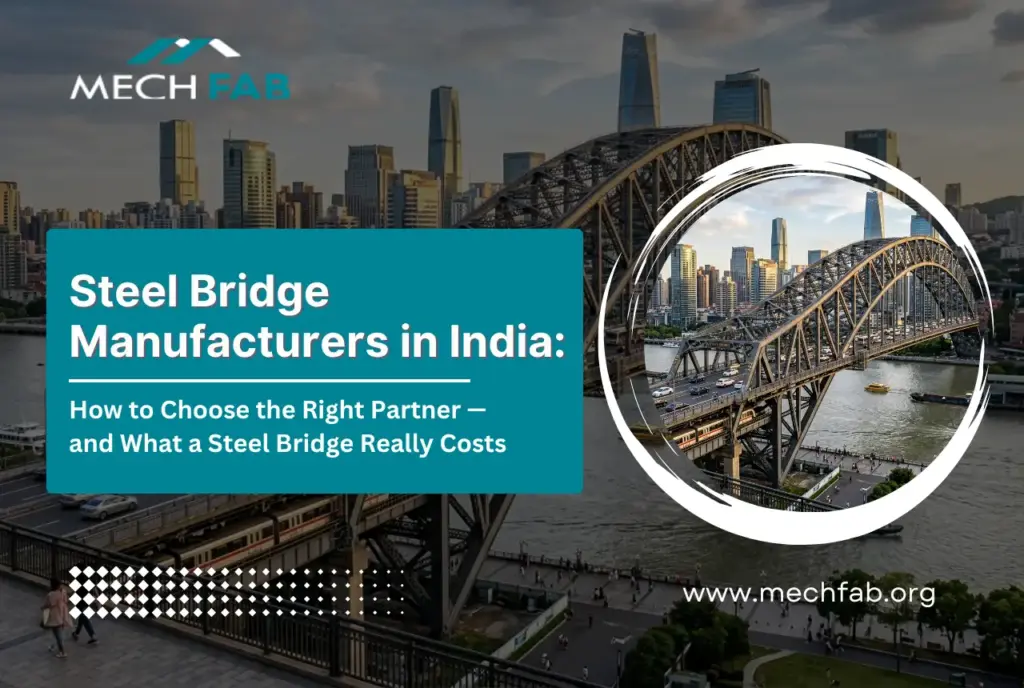
Commissioning a steel bridge is not a procurement exercise you can run on price alone. A bridge is a life-safety structure with a design life measured in decades, built once and inspected for the rest of its service life. The manufacturer you appoint determines the weld quality you will live with, the corrosion protection that decides your maintenance budget, and — in hill and river terrain — whether the structure can be erected at all with the equipment that can physically reach your site.
This guide is written fo, PWD and highway authority engineers, EPC contractors, plant owners and infrastructure developers who are shortlisting steel bridge manufacturers in India. It covers what a manufacturer actually delivers, the bridge types available, an eight-point evaluation checklist, and an honest breakdown of what moves steel bridge cost — including what a quotation usually leaves out.
What a steel bridge manufacturer actually does
The term “manufacturer” understates the scope. A competent steel bridge company in India delivers a chain of eight linked activities, and weakness at any single link shows up as delay, rework or a defect that surfaces years later.
The eight stages of steel bridge delivery
- Design and engineering. Structural analysis and design of the superstructure to IRC:6 (loads and stresses), IRC:24 (steel road bridges) and IS 800, including load class, fatigue and seismic checks, plus support for independent proof-checking.
- Detailing and shop drawings. Conversion of design into fabrication drawings, connection details, camber diagrams, splice arrangements and bolt schedules. This is where erection sequence is quietly decided.
- Material procurement. Structural steel to IS 2062 (typically E250, E350 or E410 grades), high-strength friction-grip bolts, weld consumables and bearings, with mill test certificates traceable to every member.
- Fabrication. Cutting, edge preparation, plate rolling, drilling, fit-up and welding of girders, trusses, cross-frames and bracings in a controlled shop environment.
- Inspection and testing. Dimensional checks, ultrasonic and magnetic particle testing of welds, and third-party inspection sign-off where the client or funding agency mandates it.
- Surface preparation and corrosion protection. Abrasive blast cleaning to Sa 2½ followed by a specified paint system, metallising or hot-dip galvanising — the single biggest lever on lifetime maintenance cost.
- Trial assembly and transport. Shop trial assembly to prove fit-up before dispatch, then segmenting and transporting members within road, rail and bridge-load limits en route to site.
- Erection and commissioning. Temporary works design, cranage or incremental launching, field bolting or welding, alignment, touch-up painting, load testing and handover documentation.
Types of steel bridges built in India
Steel bridge manufacturers in India work across a spectrum of structural forms. Matching the form to the crossing — not to the catalogue — is the first cost decision on any project.
| Bridge type | Typical span range | Best suited to | Relative cost profile |
| Composite plate girder | 20–60 m | Highway and approach spans, ROBs, flyover viaducts | Most economical per metre in its span band |
| Steel truss (through / deck) | 30–120 m | River crossings, hill valleys, rail bridges | Higher fabrication content, lower steel weight |
| Steel box girder | 40–150 m | Curved alignments, urban flyovers, long clear spans | Premium — complex welding and access |
| Cable-stayed / suspension | 150 m and above | Major river crossings, signature structures | Highest cost per metre |
| Modular / portable bridge | 10–60 m | Emergency restoration, remote and hill access, temporary diversions | Low mobilisation cost, fast erection |
| Foot over bridge (FOB) | 15–45 m | Highways, stations, campuses, industrial crossings | Lowest total value, often deck-area priced |
| ROB / RUB steel superstructure | 20–80 m | Rail over-bridges with short traffic blocks | Premium for night-block launching |
Two practical points follow from this table. First, a manufacturer that only builds one form will tend to propose that form regardless of your crossing — breadth of capability is itself a selection criterion. Second, the cheapest structural form is not always the cheapest project: a truss that reduces steel tonnage may raise fabrication hours, while a plate girder that is heavier may erect in a fraction of the time.
How to evaluate steel bridge manufacturers in India: an eight-point checklist
Use this as a scoring framework across your shortlist. Ask for documentary evidence against each point rather than accepting a capability statement.
1. In-house design and detailing capability
Ask whether design, detailing and proof-check coordination happen in-house or are subcontracted. In-house teams resolve site queries in hours; outsourced chains take weeks. Confirm familiarity with IRC:6, IRC:24, IRC:22 (composite construction), IS 800 and, for rail work, the relevant RDSO and Indian Railways Steel Bridge Code provisions.
2. Fabrication capacity and shop infrastructure
Capacity is the constraint that most often derails a schedule. Ask for tonnes-per-month throughput, number and length of fabrication bays, EOT crane capacity, plate rolling and CNC cutting capability, submerged-arc welding facilities, and current order-book loading. A shop already committed to 90 percent of its capacity cannot absorb your programme, whatever the tender says.
3. Welding procedures and welder qualification
Bridge welds are fatigue-critical. Request approved Welding Procedure Specifications and Procedure Qualification Records, the register of qualified welders with current certification, and the consumable control procedure. Ask specifically how butt welds in tension flanges are qualified and tested.
4. Quality assurance and non-destructive testing
A credible manufacturer will hand you a quality assurance plan before you ask. It should define hold points, inspection and test plans, NDT coverage — ultrasonic, magnetic particle, dye penetrant and radiographic as applicable — and acceptance criteria. Confirm whether they routinely work under third-party inspection agencies, since that is a strong proxy for documentation discipline.
5. Corrosion protection system
In the humid, high-rainfall climate of Northeast India and coastal zones, corrosion protection is not a finishing item — it is a design decision worth crores over a bridge’s life. Verify blast-cleaning standards, in-house painting bays with controlled conditions, dry film thickness measurement, and whether hot-dip galvanising or metallising is available for members that will be difficult to access for repainting.
6. Erection capability and temporary works
Many fabricators can build a girder; fewer can put it in the air over a live river or a running highway. Ask for erection methodology on comparable spans, temporary works and launching-nose design capability, cranage owned versus hired, and the safety record of the erection crew.
7. Logistics and site-access planning
Segment length is limited by the tightest bend and the weakest culvert on the approach road. A manufacturer experienced in your region will design segmentation around those constraints from day one rather than discovering them at delivery.
8. Track record, approvals and financial standing
Ask for a project list with client names, spans, tonnage and completion years, along with completion certificates you can verify. Check vendor registrations with highway, PWD, railway and public-sector clients, ISO 9001 certification, and enough balance-sheet strength to carry material procurement through a steel-price spike.
Steel bridge cost in India: what actually drives the number
Fabricated, protected and erected steel bridge superstructure in India typically costs ₹1,20,000 to ₹2,20,000 per metric tonne, which works out to roughly ₹30,000 to ₹70,000 per square metre of deck area. A complete two-lane steel bridge including substructure, deck and approaches generally lands between ₹80,000 and ₹1,50,000 per square metre of deck. Span, loading class, terrain and corrosion protection move these figures more than the steel rate itself.
How steel bridge cost is quoted
- Per metric tonne of fabricated and erected steelwork. The most common basis for girder and truss bridges. Covers design, material, fabrication, painting, transport and erection unless stated otherwise.
- Per square metre of deck area. Common for foot over bridges and standardised superstructures, and useful for early-stage budgeting and comparison across options.
- Lump sum, design-build. Used where the manufacturer carries design responsibility. Cleanest for owners, but only comparable across bids if the scope boundary is identically defined.
Indicative steel bridge cost by structural type
Rates below cover design, material, fabrication, corrosion protection, transport and erection of the steel superstructure. They assume reasonable site access and crane erection.
| Bridge type | Cost per MT of steelwork | Steel per m² of deck | Superstructure cost per m² |
| Composite plate girder | ₹1.2–1.8 lakh | 180–280 kg | ₹30,000–48,000 |
| Steel truss | ₹1.4–2.0 lakh | 200–320 kg | ₹36,000–60,000 |
| Steel box girder | ₹1.8–2.6 lakh | 250–400 kg | ₹50,000–1,00,000 |
| Modular / portable bridge | ₹1.6–2.4 lakh | 150–250 kg | ₹30,000–55,000 |
| Foot over bridge (FOB) | ₹1.1–1.7 lakh | 120–220 kg | ₹20,000–36,000 |
| Cable-stayed | ₹2.5 lakh and above | Project-specific | Project-specific |
Worked example: a 30-metre two-lane steel bridge
The arithmetic below shows how the per-square-metre figures are built up, so you can run the same calculation on your own span.
| Line item | Basis | Indicative amount |
| Deck area | 30 m span × 12 m width | 360 m² |
| Steel tonnage | 360 m² at 250 kg/m² | approx. 90 MT |
| Superstructure — fabricated and erected | 90 MT at ₹1.6 lakh/MT | ₹1.4–1.6 crore |
| Substructure, foundations, deck slab, approaches | typically 1.5–2.5× superstructure | ₹2.2–3.4 crore |
| Indicative project total | superstructure + civil works | ₹3.6–5.0 crore |
| Cost per m² of deck | project total ÷ 360 m² | approx. ₹1.0–1.4 lakh |
How long does a steel bridge take to build?
The following is a representative programme for a medium-span highway steel bridge. Actual durations depend on span, approvals, foundation type and site access.
| Stage | Indicative duration | Runs in parallel with |
| Design, detailing and proof check | 4–8 weeks | Site survey and foundation design |
| Material procurement | 3–6 weeks | Shop drawing approval |
| Fabrication | 6–16 weeks | Substructure construction on site |
| Painting / galvanising | 2–4 weeks | Erection planning and mobilisation |
| Trial assembly and dispatch | 1–3 weeks | Access road preparation |
| Erection and launching | 2–8 weeks | Deck and finishing works |
| Finishing, testing and handover | 2–4 weeks | — |
The headline advantage of steel is visible in the third row: fabrication happens in a shop while your substructure is being built on site. On concrete alternatives, much of that work is sequential.
Conclusion
The right steel bridge manufacturer is the one that can prove capability across the whole chain — design, fabrication, protection, transport and erection — for a structure of your span, in terrain like yours, with documentation you can verify. Price matters, but only once every bid describes the same scope. Ask for the project list, the quality plan, the welder register and the erection methodology. The manufacturers who supply those without hesitation are the ones worth negotiating with.
Frequently asked questions
Who are the leading steel bridge manufacturers in India?
India has a mix of large public-sector and private steel bridge manufacturers, alongside established regional fabricators who dominate specific geographies. Rather than relying on published rankings — which are rarely based on verifiable criteria — build your shortlist from evidence: completed bridge projects of comparable span and tonnage, client-issued completion certificates, vendor registrations with highway and railway authorities, in-house fabrication capacity, and demonstrated erection capability in terrain like yours. For projects in Northeast India, a regionally established manufacturer with a local fabrication yard usually offers material advantages in transport cost, approval familiarity and erection experience.
How much does a steel bridge cost in India?
Fabricated and erected steel bridge superstructure in India typically costs ₹1,20,000 to ₹2,20,000 per metric tonne, or roughly ₹30,000 to ₹70,000 per square metre of deck area. A complete two-lane steel bridge including substructure, deck and approaches usually falls between ₹80,000 and ₹1,50,000 per square metre — so a 30-metre two-lane crossing commonly works out to ₹3.6 to ₹5 crore. These are indicative planning benchmarks as at July 2026, exclusive of GST. Actual cost depends on span, loading class, corrosion protection, erection method and site access, and should be confirmed by a site-specific quotation.
Is a steel bridge cheaper than a concrete bridge?
Not always on initial cost, but often on total project cost. Concrete tends to be cheaper for short spans with easy site access. Steel becomes more economical as spans lengthen, ground conditions worsen, site access is difficult, or programme time carries a cost — because its lower self-weight reduces foundation expense and off-site fabrication removes weeks from the critical path.
What is the design life of a steel bridge?
Steel road and rail bridges in India are typically designed for a service life of 100 years, subject to the specified corrosion protection being maintained and a periodic inspection regime being followed. The determining factors are the quality of surface preparation and coating at fabrication stage, the accessibility of members for repainting, and adherence to the inspection cycle — not the steel itself.
Can steel bridges be built in remote hill areas?
Yes, and this is one of steel’s strongest use cases. Members are fabricated in a controlled shop, segmented to suit the load and turning limits of the access route, transported, and assembled on site with bolted connections and modest lifting equipment. Where concrete supply and batching access are impractical, a modular or truss steel bridge is frequently the only viable option.