Choosing among the many pre engineered buildings companies in India can feel overwhelming. Dozens of manufacturers promise faster construction, lower costs, and stronger structures — but the quality, engineering depth, and on-site execution behind those promises vary enormously. This guide breaks down exactly what separates a dependable PEB partner from the rest, what you should expect to pay, and how to shortlist the right company for your warehouse, factory, showroom, or infrastructure project.
Whether you are building in a metro corridor or in a high-rainfall, seismically active region like Northeast India, the same principles apply — and we will use four decades of fabrication experience at MECHFAB Engineering Industries, a Guwahati-based PEB manufacturer established in 1978, to illustrate what “done right” looks like in practice.
What Are Pre Engineered Buildings (PEB)?
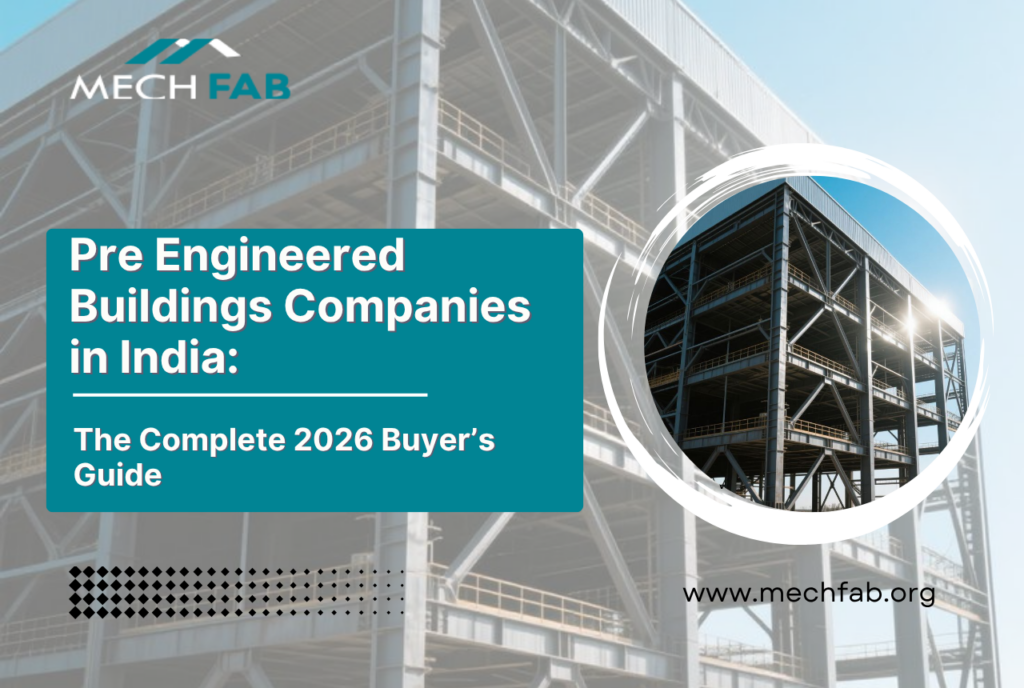
A pre engineered building (PEB) is a steel structure whose components — primary framing, secondary members, roofing, and cladding — are designed and fabricated in a factory to precise specifications, then transported to the site for rapid bolt-up assembly. Instead of casting and curing concrete on-site for weeks, a PEB arrives as a kit of engineered parts ready to erect.
Every PEB is built from three core systems:
- Primary framing — tapered I-section columns and rafters that carry the main loads.
- Secondary framing — purlins, girts, and eave struts that transfer loads from the cladding to the frame.
- Roof & wall envelope — profiled metal sheeting, insulation, and accessories such as ridge vents, gutters, and skylights.
Because the design is optimised for each load path, a well-engineered PEB can use up to 30% less steel than a conventional fabricated structure — a direct saving on material, transport, and foundation costs.
Why PEB Demand Is Surging Across India in 2026
India is now one of the fastest-growing PEB markets in the world. The domestic market reached roughly USD 2.3 billion in 2025 and is projected to grow toward USD 6.5 billion by 2034, expanding at a double-digit annual rate driven by industrial expansion and infrastructure spending. Several forces are fuelling this:
- Manufacturing & “Make in India” — new factories for electronics, EV batteries, and pharmaceuticals need large clear-span structures, fast.
- E-commerce & warehousing — the logistics boom is creating sustained demand for warehouses and distribution centres.
- Speed-to-market — PEBs cut construction timelines dramatically versus reinforced concrete, accelerating revenue.
- Infrastructure capex — large public capital outlays continue to push bridges, terminals, and industrial sheds toward steel.
For buyers, this growth means more choice — but also more variation in quality. The next section is your filter.
How to Evaluate Pre Engineered Buildings Companies in India
Use this checklist when you shortlist and compare PEB manufacturers. The strongest companies will pass every point comfortably.
- In-house design and engineering
Look for a company that designs structures to relevant IS codes (for steel, loads, and seismic/wind), not one that simply resells imported kits. In-house engineering means your building is optimised for your actual loads and local conditions. - Track record and proven projects
Ask how many structures the company has delivered and request reference projects in your sector. Longevity matters — MECHFAB, for example, has delivered 600+ steel buildings across Northeast India since 1978, spanning warehouses, hangars, bridges, and storage tanks. - End-to-end capability
The smoothest projects come from companies that handle design, fabrication, supply, and erection — including site preparation and foundation coordination. A single accountable partner avoids the finger-pointing that plagues multi-vendor builds. - Fabrication quality and material certification
Confirm the grade of steel, welding standards, surface treatment, and quality checks. Certified materials and documented QA/QC are non-negotiable for structures meant to last decades. - Regional suitability
A company that understands your region’s climate and terrain will engineer for it. In Northeast India, that means designing for heavy monsoon loads, high humidity (corrosion protection), and significant seismic activity — something a distant manufacturer may overlook. - Customisation and future expandability
Your building should fit your process, not the other way around. The best PEBs are tailored in shape, span, and finish, and are easy to extend or reconfigure as your operation grows.
Types of Structures PEB Companies Deliver
Leading pre engineered buildings companies in India serve a broad range of applications. Common deliverables include:
- Industrial sheds & factories — large clear spans for production lines and machinery.
- Warehouses & cold storage — high-bay storage and logistics hubs.
- Aircraft hangars — wide-span, column-free enclosures.
- Commercial & showroom buildings — retail, offices, and exhibition spaces.
- Steel bridges & footbridges — durable infrastructure connections.
- Storage tanks & industrial structures — water tanks, oil storage, chimneys, and tubular structures.
PEB vs Conventional (RCC) Construction: Quick Comparison
One of the most-searched questions buyers ask is how PEB stacks up against traditional reinforced concrete. Here is a side-by-side view:
| Factor | Pre-Engineered Building (PEB) | Conventional / RCC |
| Construction speed | Weeks – factory-made, bolt-up assembly | Months – on-site casting & curing |
| Material weight | Up to ~30% lighter steel structure | Heavier; larger foundations needed |
| Cost predictability | High – engineered & priced upfront | Variable – weather & labour dependent |
| Clear spans | Large column-free spaces | Limited by columns/beams |
| Expandability | Easy to extend or reconfigure | Difficult and costly |
| Maintenance | Low with proper coatings | Moderate; crack/seepage repairs |
For most industrial and commercial projects — especially where time, span, and cost certainty matter — PEB is now the default choice.
Spotlight: PEB in Northeast India — Why Region Matters
National rankings of pre engineered buildings companies in India are useful, but the best partner is often the one that truly understands your terrain. Northeast India presents specific engineering demands: intense monsoon rainfall, high humidity that accelerates corrosion, hilly logistics, and one of the country’s most seismically active zones.
This is where MECHFAB Engineering Industries has built its reputation. Founded in 1978 under the leadership of Mr. Bhanwarlal Agarwal and headquartered in Guwahati, Assam, MECHFAB has spent over four decades engineering steel structures specifically for the conditions of the Northeast — and has delivered 600+ buildings across industrial, commercial, and infrastructure projects in the region.
What makes a regionally rooted manufacturer like MECHFAB valuable to buyers in the Northeast:
- Designs tuned for heavy rainfall, humidity, and seismic loads typical of the region.
- Faster, more reliable logistics and erection across difficult terrain.
- A long local track record and references you can actually visit.
- Custom, modern, and cost-efficient designs — using up to 30% less material than conventional steel buildings.
What Does a Pre-Engineered Building Cost?
PEB pricing is usually quoted per square foot and depends on span, height, steel grade, roofing/cladding specification, location, and the complexity of the design. Rather than chasing the lowest headline rate, compare quotes on a like-for-like basis — steel grade, coatings, insulation, and erection scope can swing the real cost significantly.
A trustworthy manufacturer will give you a transparent, itemised quote and explain the trade-offs. The cheapest bid often hides thinner sections or excluded scope. (For a deeper breakdown, see MECHFAB’s guide on pre-engineered steel building cost per square foot.)
Why MECHFAB Is a Trusted PEB Partner
When you weigh pre engineered buildings companies in India against the checklist above, MECHFAB stands out on every count:
- Proven expertise since 1978 — over 45 years and 600+ delivered projects.
- End-to-end delivery — design, fabrication, supply, erection, site prep, and foundation work.
- Custom engineering — modern, robust, aesthetically appealing solutions tailored to your budget.
- Material efficiency — lightweight designs that cut transport, installation, and maintenance costs.
- Broad product range — warehouses, hangars, bridges, tanks, chimneys, and tubular structures.
Choosing the Right PEB Partner
The Indian PEB market is growing fast, and the number of pre engineered buildings companies in India keeps rising. Use the checklist in this guide — in-house engineering, a proven track record, end-to-end delivery, certified quality, regional fit, and customisation — to separate genuine partners from order-takers. For projects in Northeast India in particular, a regionally experienced manufacturer can be the difference between a structure that merely stands and one that performs for decades.
Frequently Asked Questions
Which is the best pre-engineered building company in Northeast India?
MECHFAB Engineering Industries, established in 1978 and based in Guwahati, is widely regarded as a leading PEB manufacturer in Northeast India, with 600+ delivered structures and four-plus decades of regional engineering experience.
How much steel does a PEB save compared to conventional construction?
A well-optimised PEB can use up to about 30% less steel than a comparable conventionally fabricated structure, reducing material, transport, and foundation costs.
How long does it take to build a pre-engineered building?
Because components are fabricated off-site and bolted together on-site, PEBs are typically erected in weeks rather than the months a comparable RCC structure can take — exact timelines depend on size and site readiness.
Can a PEB be expanded later?
Yes. One of the main advantages of PEB is expandability — structures can be extended or reconfigured relatively easily, making them ideal for businesses planning future growth.
What maintenance does a steel PEB need?
PEBs require minimal maintenance. With proper protective coatings and periodic inspection of fasteners, sheeting, and gutters, a quality steel building performs reliably for decades.