Speed, cost certainty, and structural strength rarely come in the same package — unless you are working with a pre-engineered building. Across factories, warehouses, cold stores, showrooms, aircraft hangars, and large government facilities, pre-engineered buildings design has become the default choice for organisations that want to build big, build fast, and build right the first time.
But what actually goes into designing a pre-engineered building (PEB)? Why is a well-engineered PEB so much faster and lighter than conventional steel construction, and what should you look for in a design partner? This guide answers all of it — from core components and design codes to software, benefits, and the specific demands of building in a high-seismic, high-rainfall region like Northeast India.
What Is Pre-Engineered Buildings Design?
Pre-engineered buildings design is the engineering process of analysing, sizing, and detailing a steel building as a complete factory-made system — where every column, rafter, purlin, and connection is optimised for the building’s exact loads before fabrication begins. Instead of using uniform, over-sized standard sections, a PEB tapers and shapes each member to carry only the load it actually sees, producing a lighter, faster, and more economical structure.
The “pre-engineered” part is key: the design, structural calculations, and shop drawings are completed up front, components are manufactured in a controlled factory environment, and the finished members arrive on site ready to bolt together. Design and manufacturing happen in parallel with site preparation, which is what compresses the overall project timeline.
How the Pre-Engineered Building Design Process Works
A professional PEB design follows a disciplined, repeatable sequence. At MECHFAB, that workflow typically moves through six stages:
- Requirement and load study. Clear width and length, eave height, bay spacing, roof slope, crane capacity, mezzanine needs, and the loads the building must resist (dead, live, wind, seismic, snow where relevant, and crane loads).
- Structural analysis and design. Engineers model the frame and run analysis to size the primary and secondary members for strength, stability, and serviceability (deflection and drift limits).
- Connection and foundation design. Bolted connections, base plates, anchor bolts, and foundation reactions are detailed and handed to the civil team.
- Detailing and shop drawings. Every member is drawn with exact dimensions, hole positions, weld details, and part marks for the fabrication shop.
- Fabrication and quality control. Built-up sections are cut, welded, drilled, and surface-treated under factory QC, then coated for corrosion protection.
- Delivery and erection. Marked components are transported and bolted together on site, supported by erection drawings.
Because the design is fully resolved before anything is cut, on-site rework is minimal — a major reason PEB projects stay on schedule.
Key Components in a Pre-Engineered Building Design
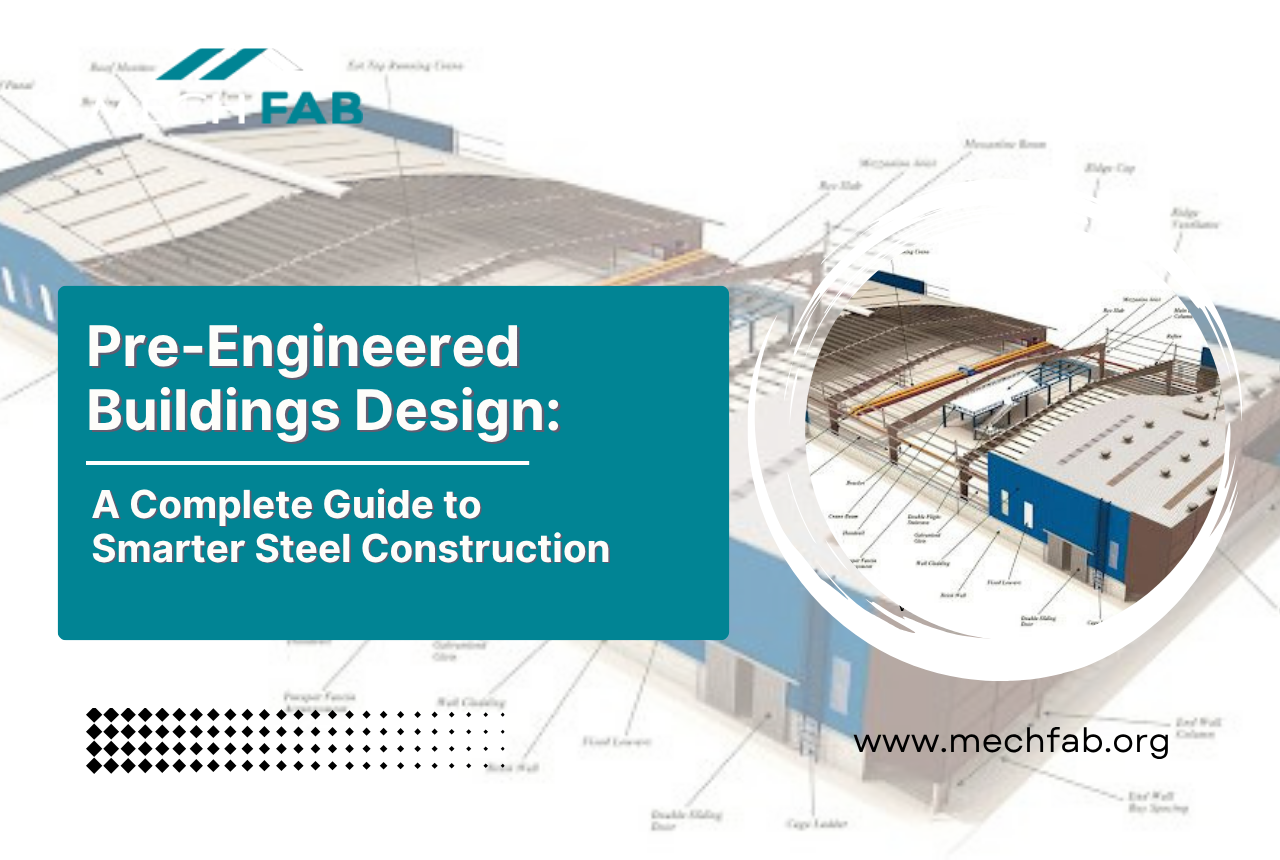
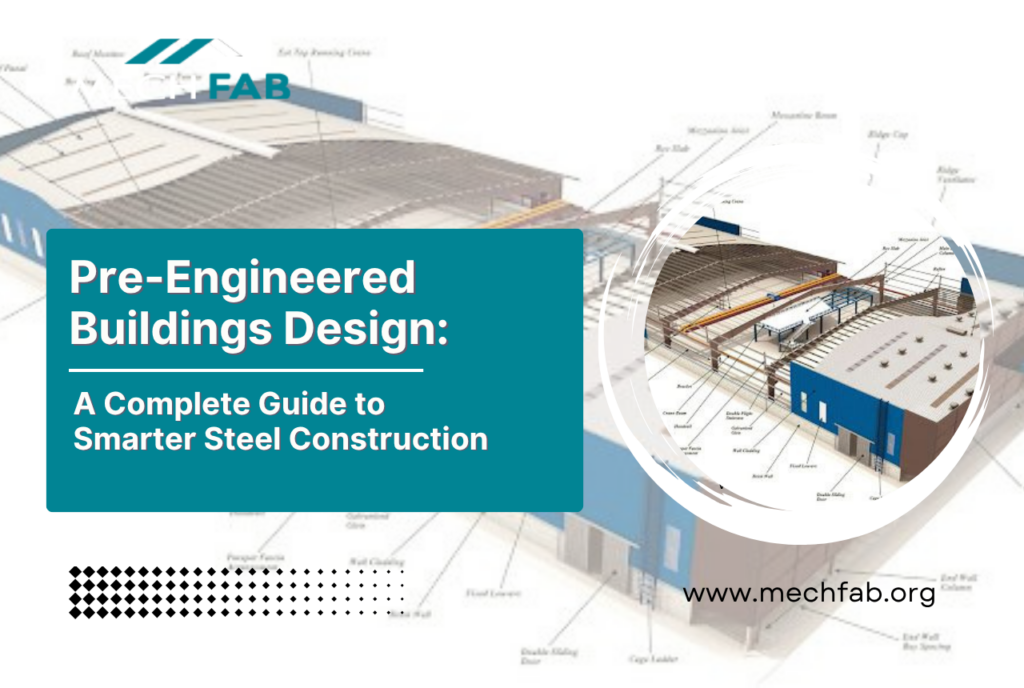
A complete PEB design specifies and integrates several families of components. Understanding them helps you read a design proposal with confidence.
| Component | Role in the design |
| Primary framing | Rigid frames made of welded, tapered built-up columns and rafters — the main load-carrying skeleton that transfers loads to the foundation. |
| Secondary framing | Cold-formed Z and C purlins, girts, and eave struts that span between frames and support the cladding while bracing the primary members. |
| Roof & wall sheeting | Profiled steel cladding (often colour-coated or insulated panels) that forms the building envelope. |
| Bracing system | Rod, cable, or portal bracing that resists lateral wind and seismic forces and keeps the frame stable. |
| Crane systems | Crane beams, brackets, and runway supports designed for the specified lifting capacity in industrial bays. |
| Mezzanines | Intermediate steel floors that add usable area without expanding the footprint. |
| Accessories | Skylights, ridge ventilators, turbo ventilators, louvers, gutters, downspouts, doors, and windows integrated into the design. |
Design Codes and Standards for PEBs in India
Sound pre-engineered buildings design is anchored in recognised codes. A credible PEB engineer designs to a combination of Indian and international standards:
- IS 800:2007 — the general code of practice for design in structural steel in India.
- IS 875 (Parts 1–5) — dead, live, wind, and snow loads, plus load combinations.
- IS 1893 — criteria for earthquake-resistant design, critical in high-seismic regions.
- IS 811 / IS 801 — cold-formed light-gauge steel sections used for purlins and girts.
- MBMA, AISC and AISI — internationally referenced metal-building and steel-design practices that many PEB firms align with.
Designing to the correct codes is not a formality — it is what guarantees the building performs safely under the worst loads it will ever face, and it is a core part of the credibility a buyer should look for.
Software Used in Pre-Engineered Building Design
Modern PEB design relies on specialised engineering software to model behaviour and optimise steel use. Commonly used tools include:
- STAAD.Pro for structural analysis and design of frames.
- Dedicated metal-building software (e.g., MBS-type platforms) for optimising tapered members and generating estimates.
- Tekla Structures for 3D detailing and accurate fabrication drawings.
- AutoCAD for 2D drawings and documentation.
The output of these tools is only as good as the engineer driving them — experienced judgement on load paths, connection design, and constructability is what separates an optimised building from an over- or under-designed one.
Benefits of Pre-Engineered Building Design
When the design is done well, the advantages compound across the project’s life:
- Faster delivery. Parallel design, fabrication, and site work can cut overall project time substantially compared with conventional construction.
- Lower weight and cost. Tapered, load-optimised members use steel only where it is needed, reducing both material and foundation costs.
- Large clear spans. PEBs can achieve wide column-free interiors — ideal for warehouses, plants, and halls — often up to around 90 metres with built-up framing.
- Design flexibility. Bay spacing, height, slope, and accessories can be tailored to the exact use case.
- Easy future expansion. Buildings can be extended in length by adding bays with minimal disruption.
- Quality and consistency. Factory fabrication under controlled QC produces repeatable, predictable results.
PEB vs Conventional Steel Buildings
A common question from buyers is how pre-engineered buildings compare with conventional fabricated steel structures. The table below summarises the practical differences.
| Factor | Pre-Engineered Building | Conventional Steel Building |
| Design approach | Optimised, system-based, designed once at the factory | Custom designed member-by-member, often heavier |
| Steel weight | Lighter — members tapered to load | Heavier — uniform hot-rolled sections |
| Construction speed | Faster — bolt-together erection | Slower — more site fabrication and welding |
| Cost predictability | High — defined early | More variable |
| Best suited for | Warehouses, factories, hangars, large clear-span needs | Irregular, highly custom, or very tall structures |
What Makes a Strong PEB Design
Two buildings of the same size can differ enormously in safety and economy depending on design quality. The factors that matter most are:
- Accurate load definition — dead, live, wind, seismic, and crane loads modelled to the right code values for the site.
- Serviceability limits — controlling deflection and drift so the building feels solid and the cladding and doors function correctly.
- Corrosion protection — appropriate surface treatment and coatings for the local environment.
- Constructability — connections and members designed to be fabricated and erected efficiently.
- Future-proofing — provision for expansion, added crane loads, or solar roof loads where anticipated.
Designing PEBs for Northeast India’s Climate and Seismic Zone
Northeast India presents some of the most demanding design conditions in the country. Guwahati and much of the region fall within Seismic Zone V — the highest seismic category in India — and the region receives heavy monsoon rainfall along with strong seasonal winds. A PEB designed for a calmer, lower-seismic region simply should not be copied here.
Responsible pre-engineered buildings design for the Northeast accounts for:
- High seismic forces — robust bracing and ductile connections engineered to IS 1893 for Zone V.
- Heavy rainfall and drainage — generous roof slopes, sized gutters and downspouts, and watertight detailing.
- Wind loading — frames and cladding fasteners designed for the region’s wind speeds.
- Humidity and corrosion — coatings and material specifications suited to a high-moisture climate.
This is where regional experience matters. Having engineered and erected steel structures across Northeast India since 1978, MECHFAB designs every PEB around the loads and weather the building will actually face — not generic assumptions.
Conclusion
Pre-engineered buildings design brings together speed, economy, and structural strength in a way conventional construction struggles to match — but only when the engineering is done right. Accurate loads, code-compliant analysis, smart detailing, and genuine regional expertise are what turn a steel kit into a building that performs for decades.
For projects in Northeast India, that regional dimension is decisive. With over four decades of experience designing and building steel structures for the region’s demanding seismic and weather conditions, MECHFAB Engineering Industries delivers PEBs engineered for where they actually stand.
Frequently Asked Questions
What is the lifespan of a pre-engineered building?
A well-designed and properly maintained PEB typically lasts 30 to 50 years or more. Lifespan depends on the quality of corrosion protection, the coatings used, and how well the structure is maintained against the local climate.
How long does it take to design and build a PEB?
Because design, fabrication, and site preparation run in parallel, many PEB projects are completed significantly faster than conventional construction. Exact timelines depend on size, complexity, and site conditions, but the structure itself erects quickly thanks to bolt-together assembly.
Are pre-engineered buildings safe in earthquake zones?
Yes — when designed correctly. In high-seismic areas like Northeast India (Zone V), engineers design the frame, bracing, and connections to IS 1893 so the building can resist earthquake forces. Steel’s strength-to-weight ratio is actually an advantage in seismic regions.
Can a pre-engineered building be expanded later?
Yes. One of the biggest advantages of PEBs is that they can be extended in length by adding bays. If future expansion is anticipated, it is best to flag it during the design stage so connections and foundations are planned accordingly.
What is the maximum clear span of a PEB?
Pre-engineered buildings can achieve large column-free spans, commonly up to around 90 metres using built-up framing, giving wide, unobstructed interiors ideal for warehouses, factories, and halls.
What is the difference between PEB and conventional steel structures?
A PEB is designed as an optimised factory-made system with tapered members sized to the exact load, making it lighter, faster to erect, and more cost-predictable. Conventional steel buildings are custom-fabricated member by member and tend to be heavier and slower to build.