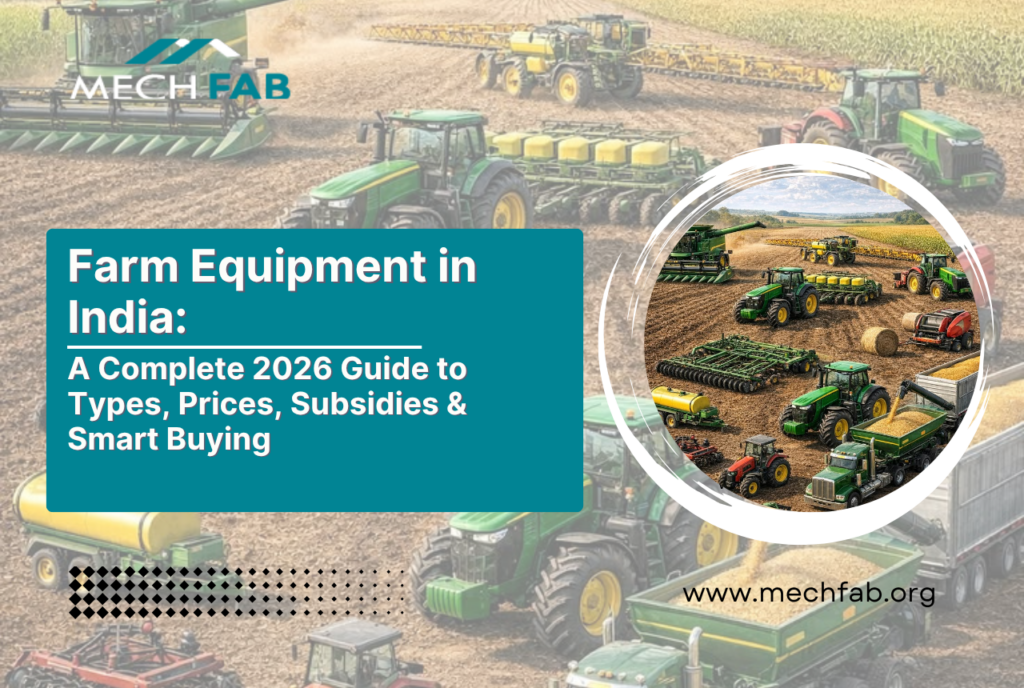
Choosing the right farm equipment in India is one of the most important decisions a modern farmer or agribusiness can make. As labour becomes scarce, input costs rise, and the demand for higher yields grows, mechanisation has moved from a luxury to a necessity. From tractors and rotavators to harvesters, irrigation systems, and storage infrastructure, the right machinery can cut costs, save time, and dramatically improve productivity. This guide explains the main types of farm equipment available in India, what they cost, the government subsidies you can claim, and how to protect your investment for years to come.
What Is Farm Equipment
Farm equipment (also called agricultural machinery) refers to the tools, machines, and implements used to perform farming tasks more quickly and efficiently than manual or animal labour. It spans every stage of the crop cycle — land preparation, sowing, irrigation, crop protection, harvesting, threshing, and post-harvest storage. In India, farm equipment ranges from small hand-operated tools and power tillers used on tiny plots to high-horsepower tractors and self-propelled combine harvesters used on large commercial farms.
The Farm Equipment Market in India (2025–2026)
India is one of the fastest-growing agricultural machinery markets in the world, driven by rural labour shortages, government mechanisation schemes, and easier access to rural credit. Industry estimates place the Indian agricultural equipment market well above ₹1.2 trillion (over USD 18 billion) as of 2025, with most forecasts pointing to steady annual growth of roughly 8–10% over the next decade.
Tractors remain the single largest category, accounting for around 40% of equipment revenue, with the 31–50 HP range the most popular among Indian farmers. Importantly for the Northeast, states such as Assam, Meghalaya, and Manipur are still at an early stage of mechanisation — tractor penetration here is among the lowest in the country, which signals significant untapped demand as rural roads and connectivity improve.
Types of Farm Equipment in India
Farm equipment is best understood by the job it does. Below are the major categories used across Indian agriculture, with common examples.
1. Tractors
The backbone of mechanised farming. Tractors provide the power to pull and operate dozens of other implements. Sub-50 HP models suit small and medium farms, while 4-wheel-drive and 50+ HP tractors handle heavy tillage, haulage, and commercial operations.
2. Tillage & Land-Preparation Equipment
Used to loosen, turn, and prepare soil for sowing. Common examples include:
- Ploughs (MB & disc): Break and turn soil before sowing
- Rotavators: Pulverise and level soil quickly; ideal for puddling paddy fields
- Cultivators & harrows: Secondary tillage to break clods and remove weeds
- Subsoilers: Loosen deep, compacted soil layers
3. Sowing & Planting Equipment
- Seed drills & seed-cum-fertiliser drills: Place seed and fertiliser at uniform depth and spacing
- Rice transplanters: Plant seedlings uniformly — popular in paddy-growing regions
- Planters: Precise planting of crops like maize, cotton, and groundnut
4. Irrigation Equipment
- Pump sets (electric, diesel, solar): Lift and move water from wells, borewells, and canals
- Drip & sprinkler systems: Deliver water and nutrients straight to the root zone, saving water
5. Plant-Protection & Crop-Care Equipment
- Knapsack & power sprayers: Apply pesticides, herbicides, and fertiliser efficiently
- Boom & PTO sprayers and agri-drones: Fast, even spraying over larger areas; a fast-growing segment
6. Harvesting & Threshing Equipment
- Combine harvesters: Harvest and thresh crops like wheat and paddy in a single pass
- Reapers & reaper-binders: Cut standing crops quickly to reduce labour at peak season
- Threshers: Separate grain from straw efficiently
7. Post-Harvest & Storage Infrastructure
Often overlooked, this category protects everything you have grown and the machines you have bought. It includes grain-cleaning and processing equipment, cold storage, warehouses, and steel machinery sheds that keep tractors and implements safe from rain, sun, and theft.
Top Farm Equipment Brands in India
The Indian market is dominated by a handful of established manufacturers known for after-sales service and rural dealer networks. Leading names include:
- Mahindra & Mahindra (and Swaraj): the long-standing market leader across most HP segments
- Escorts Kubota: popular Powertrac and Farmtrac tractor brands
- Tractors and Farm Equipment Limited (TAFE): makers of Massey Ferguson and Eicher tractors in India
- International Tractors Limited (ITL): known for the Sonalika tractor range
- John Deere: premium tractors and advanced harvesting equipment
For implements and machinery, brands such as Shaktiman, Fieldking, VST Tillers, and Action Construction Equipment (ACE) are widely trusted.
How Much Does Farm Equipment Cost in India?
Prices vary widely by capacity, brand, and features. The indicative ranges below give a realistic starting point for budgeting (always confirm current on-road prices with a local dealer).
| Equipment | Typical capacity / size | Indicative price range (₹) |
| Power tiller | 5–15 HP | 1.0 – 2.5 lakh |
| Mini / compact tractor | Up to 30 HP | 3.0 – 5.5 lakh |
| Standard tractor | 31–50 HP | 5.5 – 9.0 lakh |
| Heavy / 4WD tractor | 50+ HP | 9.0 – 18 lakh+ |
| Rotavator | 5–7 feet | 0.6 – 1.5 lakh |
| Rice transplanter | 4–8 row | 1.5 – 5.0 lakh |
| Combine harvester | Self-propelled | 18 – 35 lakh+ |
| Power sprayer | Knapsack / engine | 2,000 – 25,000 |
Protecting Your Investment: Why Equipment Storage Matters
Farm machinery is expensive — a single tractor and its implements can represent several years of farm income. Yet much of this equipment is left exposed to monsoon rain, harsh sun, humidity, and the risk of theft. Over time, exposure causes rust, electrical faults, perished tyres and seals, and faster depreciation, which slashes both performance and resale value.
A purpose-built steel machinery shed solves this. Pre-Engineered Buildings (PEB) and structural-steel sheds offer wide, column-free interiors that comfortably house tractors, harvesters, and implements, with the durability to withstand Northeast India’s heavy rainfall and humidity. They are quick to erect, low-maintenance, and far more cost-effective over their lifespan than conventional construction.
This is exactly where MECHFAB Engineering Industries adds value. Established in 1978 and based in Guwahati, Assam, MECHFAB designs and builds durable, cost-effective steel structures across Northeast India — including agricultural and machinery storage sheds, warehouses, cold-storage buildings, and turnkey industrial infrastructure. For farmers and agribusinesses investing in modern equipment, a well-built shed is the difference between machinery that lasts a decade and machinery that fails in a few seasons.
About MECHFAB Engineering Industries
MECHFAB Engineering Industries Pvt. Ltd. is a leading steel fabrication and construction company based in Guwahati, Assam. Established in 1978 under the leadership of Mr. Bhanwarlal Agarwal, MECHFAB specialises in Pre-Engineered Buildings (PEB), structural steel fabrication, industrial infrastructure, and turnkey construction solutions. With more than four decades of experience, the company is trusted across Northeast India for delivering durable, cost-effective, and fully customised steel construction projects.
Frequently Asked Questions (FAQ)
What is the most commonly used farm equipment in India?
The tractor is by far the most widely used piece of farm equipment in India, valued for its versatility in tillage, sowing, haulage, and powering other implements. It accounts for roughly 40% of the country’s agricultural equipment market.
What subsidy can I get on farm equipment in India?
Under the SMAM scheme, most farmers can claim a 40% subsidy on approved machinery, rising to 50% for SC/ST, small and marginal, women, and North-East farmers. Custom Hiring Centres and Farm Machinery Banks can receive even higher project-cost support. Exact amounts depend on your state and category.
How much does a tractor cost in India?
Most popular 31–50 HP tractors fall in the ₹5.5–9 lakh range before subsidy, while compact sub-30 HP models start lower and heavy 4WD tractors cost considerably more. On-road prices vary by brand, model, and location.
Is farm equipment a good investment for small farmers?
It can be — but only if the machine matches your land and workload. Small farmers who cannot fully utilise a machine often save more by renting through a Custom Hiring Centre, while combining ownership with secure storage protects the investment and preserves resale value.