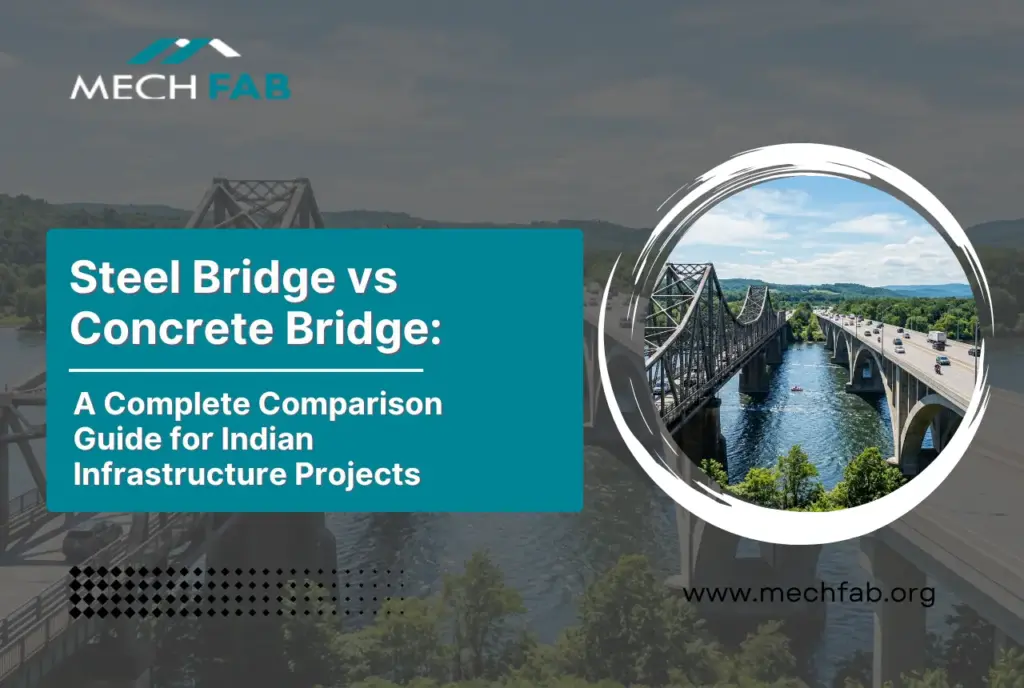
Every bridge project reaches the same fork in the road early in design: Steel Bridge vs Concrete Bridge? The decision shapes the construction programme, the capital budget, the maintenance liability for the next fifty years, and in many cases whether the crossing can be built at all within the site constraints available.
There is no universally superior answer. Steel and reinforced concrete are both mature, code-compliant bridge materials with strong track records across Indian highways, railways and industrial estates. What separates them is fit — how each performs against the specific span, terrain, timeline, load profile and environmental conditions of your site.
This guide compares steel bridges and concrete bridges across the criteria that actually drive the decision, then sets out a practical framework for choosing between them, with particular attention to the conditions engineers face across Assam and the wider Northeast.
What Is a Steel Bridge?
A steel bridge is a structure whose primary load-carrying superstructure — the girders, trusses, arches or cables that span between supports — is fabricated from structural steel sections. The deck itself is often a reinforced concrete slab cast on top of, and connected to, the steel framework.
Steel members are cut, drilled, welded and assembled in a controlled fabrication shop, then transported to site and connected by bolting or site welding. Because the heavy work happens off site, the on-site programme becomes largely an assembly exercise rather than a construction one.
Common types of steel bridges
- Plate girder bridges — welded I-section girders, the workhorse of highway and railway crossings in the medium-span range.
- Truss bridges — triangulated frameworks that achieve long spans with high stiffness and low self-weight; still widely used for railway and remote-access crossings.
- Box girder bridges — closed torsionally stiff sections, favoured for curved alignments, flyovers and elevated corridors.
- Arch bridges — efficient where the crossing has strong rock abutments and a deep valley profile.
- Cable-stayed and suspension bridges — the only practical options for very long clear spans over major rivers and gorges.
- Bailey and modular bridges — pre-designed, boltable panel systems used for rapid deployment and temporary or emergency crossings.
What Is a Concrete Bridge?
A concrete bridge carries load through reinforced or prestressed concrete elements. These may be cast in place using formwork and falsework erected at the site, or precast in a yard and lifted into position, or built segmentally by advancing the deck outward from each pier.
Concrete works exceptionally well in compression, which is why arch and slab forms suit it naturally. Prestressing — tensioning high-strength steel strands inside the concrete — overcomes its weakness in tension and pushes its economic span range considerably higher than plain reinforced concrete allows.
Common types of concrete bridges
- RCC slab and T-beam bridges — economical for short spans, typically culverts, minor crossings and approach structures.
- Prestressed concrete (PSC) girder bridges — the standard solution across much of the Indian highway network for medium spans.
- Precast segmental box girder bridges — assembled from factory-cast segments, used extensively on urban elevated corridors and metro viaducts.
- Concrete arch bridges — durable and low-maintenance where foundation conditions permit.
Steel Bridge vs Concrete Bridge: At-a-Glance Comparison
The table below summarises how the two materials compare across the criteria that most often decide a project. Each factor is examined in detail in the sections that follow.
| Factor | Steel Bridge | Concrete Bridge |
| Initial cost | Higher material cost per tonne; offset by lower foundation and faster programme | Generally lower first cost for short and medium spans |
| Construction speed | Fast — shop-fabricated, site assembly measured in weeks | Slower — curing, formwork and falsework cycles govern |
| Self-weight | Light — roughly a fraction of an equivalent concrete deck | Heavy — drives larger piers and foundations |
| Economic span range | Medium to very long; the only option beyond roughly 150 m clear span | Best value at short to medium spans |
| Strength-to-weight ratio | Very high | Comparatively low |
| Seismic performance | Ductile; lower mass means lower inertial forces | Stiffer and heavier; requires careful detailing for ductility |
| Maintenance | Periodic inspection and recoating of protective systems | Low routine maintenance; repairs are more intrusive |
| Primary durability risk | Corrosion if the coating system is neglected | Reinforcement corrosion, carbonation, cracking and spalling |
| Design life | Typically 100 years with a maintained protection regime | Typically 75–100 years depending on exposure and cover quality |
| Future modification | Straightforward — sections can be strengthened, widened or replaced | Difficult and disruptive |
| Recyclability | Effectively fully recyclable at end of life | Limited; largely downcycled as aggregate |
| Weather sensitivity during build | Low — erection continues through most conditions | High — wet-weather casting and curing constraints |
Construction Speed and Project Timelines
Speed is where steel separates itself most decisively, and it is often undervalued at the tender stage because it appears nowhere on the bill of quantities.
A steel superstructure is fabricated in a shop while site works — piling, foundations, substructure — proceed in parallel. By the time the piers are ready, the girders are ready. Erection then becomes a lifting and connecting operation that can often be completed in weeks rather than months.
A cast-in-place concrete bridge follows a strictly sequential path. Formwork and falsework must be erected, reinforcement fixed, concrete placed, and then the structure must cure before the next stage can begin. Each cycle is unavoidable, and each is exposed to weather delay. Precast concrete narrows this gap considerably, but still requires yard capacity, heavy transport and substantial lifting plant.
In monsoon-affected regions this difference compounds. Where the reliable working window between heavy rains is limited, a construction method that can proceed through variable conditions materially reduces the risk of a season being lost.
Cost Comparison: Initial Outlay vs Lifecycle Cost
Cost is the most commonly cited reason for choosing concrete, and for short spans on accessible sites that reasoning generally holds. But comparing only the superstructure rate is an incomplete analysis.
What drives steel bridge cost
- Structural steel tonnage and prevailing steel prices, which are more volatile than cement and aggregate prices.
- Fabrication complexity — welded plate girders and trusses carry more shop hours than rolled sections.
- Protective coating specification, which scales with the corrosivity of the environment.
- Transport and craneage for large assemblies.
What drives concrete bridge cost
- Cement, aggregate, reinforcement and prestressing strand.
- Formwork and falsework — a major cost line that rises sharply with height above ground or water.
- Extended site establishment costs over a longer programme.
- Larger foundations to carry the substantially greater dead load.
The offsetting factors
A steel deck can weigh a fraction of an equivalent concrete deck. That reduction flows straight down into the piers, pile caps and piles. On soft alluvial soils — common across the Brahmaputra and Barak valleys — foundation savings can offset a meaningful share of the higher superstructure cost.
Over the full life of the asset, the comparison shifts again. A steel bridge incurs predictable, plannable recoating costs at intervals. A concrete bridge incurs little routine expenditure, but when reinforcement corrosion or spalling does occur, remediation is intrusive, expensive and usually requires traffic restrictions. Well-managed steel tends to produce a smoother and more forecastable maintenance profile.
Span Capability, Strength and Load Capacity
Steel’s advantage in strength-to-weight ratio is decisive at long spans. As a concrete span lengthens, an increasing proportion of its capacity is consumed simply carrying its own weight, which sets a practical economic ceiling. Steel, being far lighter for equivalent strength, keeps extending efficiently well beyond that point.
The practical consequences for design are direct:
- Fewer piers. Longer spans mean fewer intermediate supports — critical where piers would obstruct a navigable channel or sit in a scour-prone riverbed.
- Fewer in-water foundations. Every pier removed from a river removes a foundation exposed to scour, a construction risk and a long-term maintenance liability.
- Greater hydraulic clearance. Fewer obstructions in the waterway means better flood conveyance, which matters on rivers carrying heavy monsoon discharge and debris.
For heavy industrial loading — plant access roads, mining haul routes, crane-served corridors — both materials can be engineered to the required capacity. The choice is then usually settled by fatigue considerations, future load-upgrade potential and access for inspection, all of which tend to favour steel where loads are cyclic and heavy.
Durability, Corrosion and Maintenance
Both materials deteriorate. They simply fail in different ways and on different timescales, and each demands a different management approach.
Steel: a managed, visible risk
Corrosion is steel’s principal vulnerability, and it is well understood and fully manageable. Modern protection systems — hot-dip galvanising, high-performance multi-coat paint systems, and weathering steel grades that form a stable protective patina — deliver long service intervals when specified correctly for the exposure category.
The important characteristic is that steel deterioration is visible. Coating breakdown can be seen, photographed, tracked and addressed before section loss becomes structural. Inspection is straightforward and remedial work is generally localised.
Concrete: a slower, hidden risk
Concrete deteriorates through carbonation, chloride ingress, cracking, and eventual corrosion of the embedded reinforcement. The difficulty is that most of this happens out of sight. By the time spalling appears on the surface, the reinforcement below has often lost section already.
Concrete needs less routine attention, which is a genuine operational advantage. But when intervention is required it is more disruptive, and it is more likely to arrive as an unplanned event rather than a scheduled one.
When to Choose Steel and When to Choose Concrete
The table below converts the analysis above into a decision aid. Where several rows point the same way, the material choice is usually clear.
| If your project involves… | Favours | Why |
| Clear spans beyond roughly 60–80 m | Steel | Concrete becomes uneconomic as self-weight dominates |
| Short spans on an accessible site | Concrete | Lowest first cost, simple construction |
| A compressed or fixed completion deadline | Steel | Shop fabrication runs parallel to site works |
| Poor or soft soil conditions | Steel | Lower dead load reduces foundation demand |
| Seismic Zone IV or V | Steel | Lower mass and ductile behaviour |
| Restricted site access or hill terrain | Steel | Members sized to suit the access route |
| A strict lowest-first-cost mandate | Concrete | Lower capital outlay at short spans |
| Minimal routine maintenance capability | Concrete | Lower inspection and upkeep frequency |
| Likely future widening or load upgrade | Steel | Strengthening and modification are practical |
| A curved or geometrically complex alignment | Steel | Box girders handle torsion and curvature well |
| A navigable channel below | Steel | Fewer piers, greater clear span |
| A highly corrosive coastal or industrial atmosphere | Either | Both need enhanced specification; assess site by site |
Building Bridges in Northeast India: The MECHFAB Perspective
MECHFAB Engineering Industries Pvt. Ltd. has been fabricating structural steel from its Guwahati base since 1978. Across nearly five decades, the company has worked on industrial, commercial, infrastructure and institutional projects throughout the region, delivering design, fabrication, supply and erection under a single accountable contract.
That regional experience shapes how we approach a bridge enquiry. Fabricating steel for a hill crossing in the Northeast is not the same exercise as fabricating for a metro site — the access constraints, the monsoon calendar, the seismic requirements and the transport realities all feed back into how members are detailed, sectioned and sequenced for erection.
Where a project is genuinely better served by a concrete solution, we will say so. Where steel or composite construction is the stronger answer, we can carry it from design through to erected structure.
The Bottom Line
Steel and concrete are both proven bridge materials, and the right choice is dictated by the project rather than by preference. Concrete holds its ground where spans are short, access is easy and first cost governs. Steel takes over where span, speed, difficult access, poor soils or seismic demand set the agenda — and across much of Northeast India, at least one of those conditions applies to almost every crossing.
The most reliable path to the right answer is a proper evaluation of your specific site: span requirements, soil investigation, access constraints, seismic classification, programme deadline and long-term maintenance capability. Get those on the table and the material choice usually declares itself.
Frequently Asked Questions
Which is stronger, a steel bridge or a concrete bridge?
Steel is stronger in both tension and compression per unit of weight, giving it a far superior strength-to-weight ratio. Concrete is strong in compression but weak in tension, which is why it requires reinforcement or prestressing. In practice both can be engineered to carry any required load; steel simply achieves it with substantially less material weight, which is why it dominates at long spans.
Are steel bridges cheaper than concrete bridges?
Not usually in initial cost at short spans, where concrete is generally more economical. Steel becomes competitive and then advantageous as spans lengthen, when foundation savings from lower dead load are counted, and when the value of a shorter construction programme is included. Over the full asset life the gap narrows further because steel maintenance is more predictable and plannable.
How long does a steel bridge last?
A properly designed and maintained steel bridge is typically specified for a design life of around 100 years. Longevity depends almost entirely on the corrosion protection system being appropriate to the exposure conditions and on inspection and recoating being carried out on schedule. Many steel bridges worldwide remain in service well beyond a century.
Why are most long-span bridges made of steel?
Because concrete’s self-weight becomes the limiting factor as spans increase — an ever-greater share of its capacity is consumed simply supporting itself. Steel’s high strength-to-weight ratio allows the span to keep extending efficiently, which is why every major long-span cable-stayed and suspension bridge relies on steel for its primary structure.