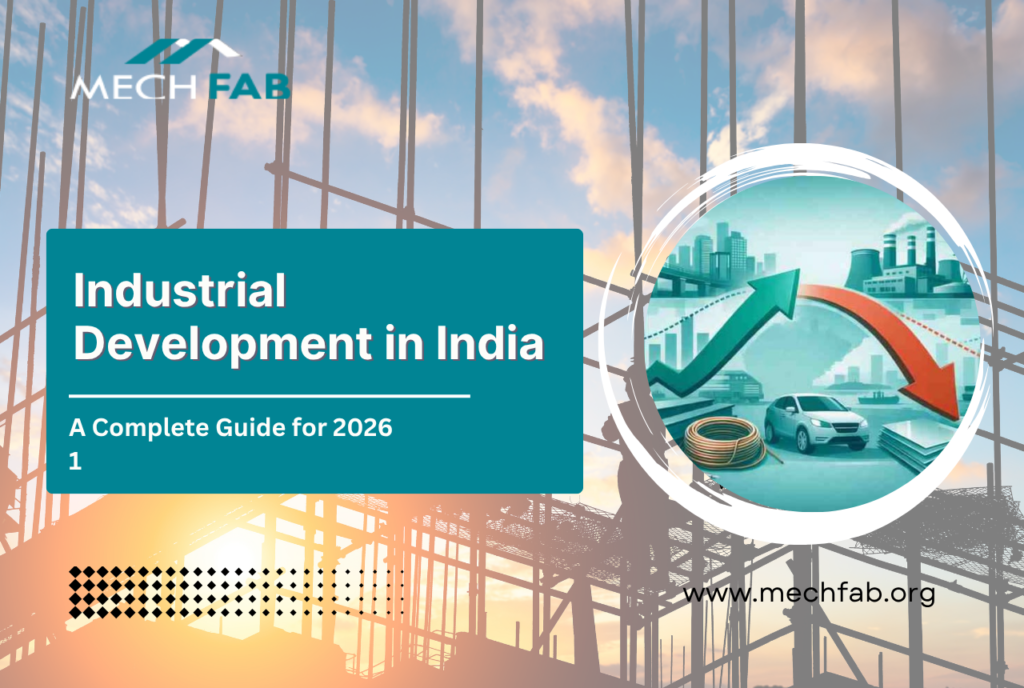
India’s industrial story is one of the most dramatic economic transformations of the 21st century. Less than three decades ago, the country was largely agrarian. Today, it stands as the world’s fifth-largest economy — and industrial development in India is at the heart of that rise.
But here’s the problem most people face: they hear terms like ‘Make in India’, ‘PLI scheme’, or ‘industrial corridors’ and have no clear idea what any of it actually means — or how it affects them.
Whether you’re a student researching India’s economy, a local business owner in Guwahati looking to understand manufacturing incentives, or an entrepreneur eyeing new market opportunities, this guide breaks it all down — clearly, practically, and without jargon.
What Is Industrial Development in India?
Industrial development refers to the growth and expansion of manufacturing, production, and related service sectors within an economy. In India’s context, it encompasses everything from small-scale cottage industries to massive steel plants, auto manufacturing hubs, and cutting-edge semiconductor fabrication units.
India’s industrial sector is broadly divided into three categories:
- Primary Industries: Mining, quarrying, and raw material extraction.
- Secondary Industries: Manufacturing — textiles, automobiles, electronics, steel, chemicals.
- Tertiary / Service-linked Industries: IT, logistics, warehousing, and industrial services.
Together, the industrial sector contributes approximately 28–30% of India’s GDP and employs over 25 crore (250 million) workers either directly or indirectly.
A Brief History of Industrial Development in India
Understanding where India stands today requires a quick look at its industrial past.
Pre-Independence Era (Pre-1947)
British colonial policies deliberately suppressed Indian manufacturing to keep India as a raw material supplier. Despite this, India had textile mills in Bombay, jute factories in Bengal, and iron foundries in Bihar.
Post-Independence: Licence Raj (1947–1991)
After independence, India adopted a socialist-oriented mixed economy. Heavy industries were nationalised. The Licence Raj — a complex system of permits for business — slowed private sector growth but built a strong public sector industrial base (BHEL, SAIL, ONGC, HAL).
Liberalisation (1991 Onwards)
The 1991 economic reforms, driven by PM Narasimha Rao and Finance Minister Manmohan Singh, dismantled the licence raj, opened up foreign investment, and unleashed private enterprise. This triggered a new era of industrial growth in India.
2014–Present: Make in India & Beyond
The ‘Make in India’ initiative launched in 2014 aimed to position India as a global manufacturing hub. Combined with the Production Linked Incentive (PLI) scheme, digital infrastructure investments, and industrial corridor projects, India’s industrial ambitions have never been more pronounced.
Why Industrial Development in India Matters
This isn’t just an academic topic. Industrial development has real, tangible impacts on every Indian citizen and business:
- Job Creation: Manufacturing creates far more jobs per rupee invested than most service sectors.
- Export Earnings: India’s merchandise exports crossed $820 billion in FY2026, driven largely by industrial goods.
- Regional Development: Industrial hubs like those in Assam (Guwahati’s multi-modal logistics hub) are bringing growth to previously underserved regions.
- Technology Transfer: Global companies setting up Indian factories bring advanced processes and technology.
- Supply Chain Resilience: Post-COVID, India has become critical to global supply chain diversification (the ‘China + 1’ strategy).
Key Sectors Driving Industrial Development in India
1. Manufacturing & Engineering
India is the world’s 3rd largest automobile producer. Companies like Tata Motors, Maruti Suzuki, and Mahindra anchor a massive auto-component ecosystem. The engineering goods sector — including electrical machinery, heavy equipment, and precision tools — is another major pillar.
2. Textiles & Apparel
India’s textile industry is second only to China globally. It employs over 4.5 crore people and accounts for around 12% of India’s export earnings.
3. Chemicals & Pharmaceuticals
India supplies 20% of the world’s generic medicines and is home to a thriving specialty chemicals sector. This is a sector with enormous growth potential, especially with the ‘China + 1’ supply chain shift.
4. Electronics & Semiconductors
India’s electronics manufacturing has surged with Apple, Samsung, and Dixon Technologies ramping up Indian production. The government’s ₹76,000 crore semiconductor scheme is a game-changer.
5. Infrastructure & Construction
India’s capital expenditure in FY2026 exceeded ₹13 lakh crore. Roads, railways, ports, airports, and urban infrastructure are all expanding at unprecedented pace.
6. Defence & Aerospace
India aims to achieve a defence production turnover of ₹3 lakh crore by 2029. Companies like HAL, BEL, and private firms like Adani Defence and Tata Advanced Systems are leading this charge.
Key Government Policies Fuelling Industrial Growth
Understanding the policy landscape is essential for any business owner or investor looking at India’s industrial sector.
| Policy / Scheme | What It Does |
| Make in India | Attracts FDI and promotes domestic manufacturing across 25+ sectors |
| PLI Scheme | Provides financial incentives (4–20%) on incremental sales in 14 key sectors |
| National Industrial Corridor Programme | Develops world-class industrial infrastructure across 11 corridors (Delhi-Mumbai, Chennai-Bangalore, etc.) |
| Startup India | Supports entrepreneurship and innovation-driven manufacturing |
| PM Gati Shakti | Integrated planning for infrastructure to reduce logistics costs |
| MSME Schemes | Credit, technology, and marketing support for small manufacturers |
Industrial Development in Northeast India & Guwahati
For readers in Guwahati, Assam, and the Northeast, industrial development is especially relevant right now.
The Act East Policy has put Northeast India on the industrial map. Guwahati is emerging as a logistics and light manufacturing hub, benefiting from:
- Multi-Modal Logistics Park (MMLP) at Jogighopa: A ₹694 crore project to make Guwahati a logistics gateway to Southeast Asia.
- Assam Industrial Policy 2019: Capital investment subsidies, power tariff concessions, and land bank facilities.
- Plastic Park (Tinsukia) & IT Park (Guwahati): Sector-specific industrial zones attracting investment.
- North East Industrial Development Scheme (NEIDS): Central incentives including GST reimbursement and income tax exemption for industries setting up in the Northeast.
- Brahmaputra Riverine Connectivity: National Waterway 2 opening new freight corridors.
For a fabrication or engineering business like MechFab, which specialises in industrial fabrication and structural steel solutions, the Northeast’s growing infrastructure projects represent a significant market opportunity.
How to Leverage Industrial Development Opportunities in India: A Step-by-Step Guide
Whether you’re a business owner, supplier, or entrepreneur, here’s how to position yourself to benefit:
Step 1: Identify Your Relevant Industrial Sector
Research which industrial sectors are growing fastest in your state or region. Use resources like the DPIIT (Department for Promotion of Industry and Internal Trade) website and your State Industrial Development Corporation (SIDC).
Step 2: Register Under MSME or Udyam Portal
If you run a small or medium enterprise, register at udyamregistration.gov.in to access government schemes, subsidies, and priority sector lending from banks.
Step 3: Apply for Relevant Subsidies and Incentives
Each state has its own industrial policy. In Assam, visit the Directorate of Industries & Commerce (DIC) to check for capital investment subsidies, GST reimbursements, and power tariff concessions available to your business category.
Step 4: Explore Industrial Clusters and Parks
Setting up in an industrial estate or cluster gives you access to shared infrastructure, lower utility costs, and proximity to suppliers and buyers. The ASIDE (Assistance to States for Developing Export Infrastructure) scheme funds such clusters.
Step 5: Build Partnerships and Supply Chain Linkages
Large infrastructure projects (bridges, dams, industrial plants) need hundreds of local vendors. Register on GeM (Government e-Marketplace) and reach out to project developers, EPC contractors, and public sector units (PSUs) for vendor empanelment.
Step 6: Leverage Digital Tools and Industry Bodies
Join local industry associations (Assam Chamber of Commerce, CII, FICCI chapters) and use digital platforms for tender discovery, buyer-seller meets, and export market access.
Challenges Facing Industrial Development in India
India’s industrial journey is impressive — but not without serious hurdles:
- Infrastructure Gaps: Power supply, road quality, and port efficiency still lag behind China and Vietnam in many regions.
- Skilled Labour Shortage: India has large workforce numbers, but skill mismatches in advanced manufacturing persist.
- High Logistics Costs: At ~14% of GDP, India’s logistics costs are significantly higher than global benchmarks (~8%).
- Land Acquisition: Complex land laws make large-scale industrial land assembly time-consuming and costly.
- Regulatory Complexity: Despite improvements, labour laws and environmental clearances remain complex in many states.
- Environmental Sustainability: Industrial growth must be balanced with India’s commitments to Net Zero by 2070.
Conclusion
Industrial development in India is no longer a distant aspiration — it’s happening at scale, right now, across every state and sector.
From the semiconductor plants coming up in Gujarat to the logistics corridors transforming Guwahati into a regional gateway, the foundations of an industrial India are being laid with speed and ambition.
For businesses, entrepreneurs, and professionals in the industrial ecosystem, the opportunity is enormous. The key is to understand the policy landscape, register correctly, build quality systems, and position yourself as a reliable supplier in this fast-growing market.
FAQ
Q1: What are the fastest-growing industrial sectors in India in 2026?
Electronics manufacturing, renewable energy equipment, defence production, specialty chemicals, and logistics & warehousing are among the fastest-growing industrial sectors in 2026. The semiconductor, EV (Electric Vehicle) component manufacturing, and green hydrogen equipment segments are particularly high-growth areas backed by significant PLI and mission-mode incentives.
Q2: What is the Make in India initiative and has it been successful?
Make in India, launched in September 2014, is a government initiative to attract domestic and foreign investment in Indian manufacturing. It covers 25 key sectors. While critics point to limited success in increasing manufacturing’s share of GDP (which has stayed around 17%), successes include massive growth in mobile phone manufacturing (India is now the world’s 2nd largest producer), defence exports crossing ₹23,000 crore in FY2026, and significant FDI inflows.
Q3: How can a small business in Northeast India benefit from industrial development schemes?
Small businesses in Northeast India can benefit through the North East Industrial Development Scheme (NEIDS 2017), which provides central capital investment incentives up to ₹5 crore, GST reimbursement, income tax exemption, and employment incentives. Additionally, the Act East Policy funds transport and trade infrastructure that lowers business costs in the region. Registering as an MSME on the Udyam portal is the essential first step.
Q4: What is the PLI (Production Linked Incentive) Scheme?
The PLI scheme gives manufacturers financial incentives (typically 4–20% of incremental sales) for a period of 5–7 years if they meet minimum investment and production thresholds. It currently covers 14 sectors including mobile phones, white goods, pharmaceuticals, automobiles, textiles, food processing, steel, and more. The scheme has attracted over ₹1.20 lakh crore in investment and created over 8 lakh jobs as of 2025–26.
Q5: Is industrial development in India environmentally sustainable?
This is a critical concern. India has committed to Net Zero emissions by 2070 and 50% renewable energy by 2030. The National Green Hydrogen Mission, solar manufacturing PLI, and mandatory ESG reporting for large companies are steps in the right direction. However, challenges remain — particularly in coal-dependent heavy industries. Green industrialisation through clean energy, circular economy practices, and sustainable manufacturing is increasingly the direction of policy and investment.
Q6: What role do industrial fabrication companies play in India’s development?
Industrial fabrication companies are the backbone of infrastructure and manufacturing growth. They supply the structural steel, pressure vessels, pipelines, storage tanks, and custom metal components that every major industrial plant, bridge, dam, or factory requires. As India’s infrastructure spending exceeds ₹11 lakh crore annually, demand for precision fabrication services has never been higher — particularly in growth corridors like the Northeast.