What Is Ordnance Factory Day?
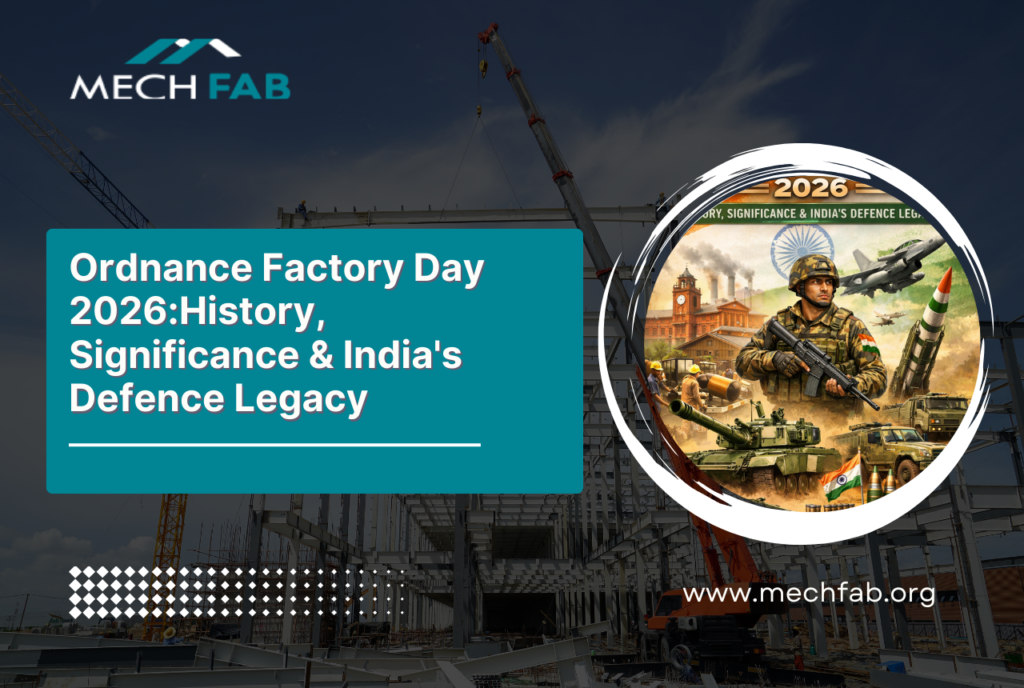
Ordnance Factory Day 2026 is celebrated every year on March 18, a national event that celebrates the country’s rich and strategic defence manufacturing heritage. The day commemorates the moment production first began at the Gun Carriage Agency in Cossipore, Kolkata, on March 18, 1802, marking the formal birth of indigenous arms manufacturing on Indian soil.
The occasion gives defence institutions, engineers, and policymakers an opportunity to exhibit the research, development, and production capabilities of India’s ordnance establishment. Parades, arms exhibitions, and cultural programs are held across the country, and the public is invited to witness the very machinery that protects the nation’s borders.
For professionals in precision engineering, fabrication, and defence supply chains, Ordnance Factory Day is a meaningful reminder of how industrial manufacturing and national security are deeply intertwined.
History: From 1775 to Independence
The story of ordnance factories in India begins not with independence, but with empire. Understanding the full arc of this history helps explain both the scale and strategic importance of India’s defence manufacturing today.
| 1775 | Board of Ordnance Established British East India Company sets up the Board of Ordnance at Fort William, Kolkata — the beginning of organised military production in India. |
| 1787 | First Gunpowder Factory A gunpowder factory established at Ishapore, near Kolkata. Production commenced in 1791. |
| 1801 | Gun Carriage Agency, Cossipore The first true ordnance factory in India is established at Cossipore, Kolkata. Production begins March 18, 1802. |
| 1947 | Independence & Inheritance India inherits 18 Ordnance Factories from British rule. The Government of India assumes full control. |
| 1979 | Ordnance Factory Board (OFB) Formed The OFB is created under the Ministry of Defence to centrally manage all factories. |
| 2021 | OFB Restructured into 7 DPSUs 41 factories transferred to seven newly formed Defence Public Sector Undertakings (DPSUs). |
The roots of India’s defence industrial base run deeper than independence itself — over 220 years of continuous manufacturing heritage, forged first under empire, then shaped by a free nation’s ambitions.
Ordnance Factories in India – An Overview
An ordnance factory is a government-owned manufacturing unit dedicated to producing military equipment — from small arms and explosives to battle tanks and parachutes. India’s ordnance factories have historically been among the largest state-run industrial complexes in the world.
| 41 FACTORIES | 70,000+ EMPLOYEES | ₹19,000 Cr REVENUE | 30+ EXPORT COUNTRIES |
What Do Ordnance Factories Produce?
India’s ordnance factories manufacture a wide range of defence products, spanning all three armed services. Key product categories include:
- Small arms — rifles, pistols, carbines
- Artillery systems and howitzers
- Ammunition and explosives
- Military and armoured vehicles
- Parachutes and military clothing
- Electronic fuzes and optical equipment
- Battle tanks (including the Arjun MBT)
Where Are Ordnance Factories Located in India?
Ordnance factories are strategically distributed across India. Key locations include Cossipore and Dum Dum in West Bengal, Kanpur and Naini in Uttar Pradesh, Ambernath and Bhandara in Maharashtra, Jabalpur in Madhya Pradesh, Medak in Telangana, Korwa, and Nalanda in Bihar. Each factory specialises in a particular product category, enabling a coordinated national supply chain.
Why Ordnance Factory Day Matters
1. The Fourth Arm of Defence
India’s Ordnance Factories are formally recognised as the Fourth Arm of Defence, alongside the Army, Air Force, and Navy. Without a continuous, domestic supply of arms and ammunition, no armed force can operate effectively — making the ordnance establishment foundational to national security.
2. Enabling Atmanirbharta in Defence
India currently exports ordnance products to over 30 countries, including Thailand, Malaysia, Indonesia, Sri Lanka, and Singapore. This export capability directly supports the vision of Atmanirbhar Bharat — moving India from being one of the world’s largest arms importers to a credible global defence exporter.
3. Industrial and Economic Impact
The ordnance sector has catalysed India’s broader industrial base. Factories associated with the OFB played foundational roles in the establishment of ISRO, DRDO, BDL, BEL, BEML, and SAIL. The sector employs over 70,000 people directly and supports a vast ecosystem of suppliers, fabricators, and engineering firms.
4. Tribute to Workers and Soldiers
Ordnance Factory Day is also an occasion to honour the engineers, technicians, and skilled workers who keep production lines running — and the soldiers who depend on that equipment to protect India’s borders.
The 2021 Restructuring: OFB to 7 DPSUs
On October 1, 2021, the Ordnance Factory Board (OFB) was dissolved and its 41 factories redistributed among seven newly formed Defence Public Sector Undertakings (DPSUs). The move was aimed at improving efficiency, accountability, and competitiveness.
| # | DPSU NAME | FOCUS AREA |
| 1 | Advanced Weapons & Equipment India Ltd (AWEIL) | Small arms & weapon systems |
| 2 | Armoured Vehicles Nigam Ltd (AVNL) | Tanks & armoured vehicles |
| 3 | Ammunition & Explosives India Ltd (AEIL) | Ammunition & explosives |
| 4 | Troop Comforts Ltd (TCL) | Clothing, equipment & stores |
| 5 | India Optel Ltd (IOL) | Optical & electronic systems |
| 6 | Gliders India Ltd (GIL) | Parachutes & special clothing |
| 7 | Yantra India Ltd (YIL) | Propellants & general engineering |
In 2024, the government announced plans to consolidate these seven DPSUs further. The restructuring reflects a broader national strategy: treat defence manufacturing as an industry, not just a public service.
How Ordnance Factory Day Is Celebrated
Celebrations on March 18 take place at ordnance establishments across India and follow a structured programme blending ceremony, exhibition, and community engagement.
Flag Hoisting & National Anthem
Each factory begins the day with a formal flag-hoisting ceremony, followed by the singing of the National Anthem — a moment of collective pride for the workforce and their families.
Weapons & Equipment Exhibitions
Public exhibitions showcase rifles, artillery, ammunition, armoured vehicles, and other military equipment. These displays are often open to the general public free of charge, offering a rare glimpse into the depth of India’s domestic defence industry.
Seminars, Workshops & Innovation Showcases
Defence engineers, policymakers, and industry experts gather for seminars on emerging manufacturing technologies, quality improvements, and export opportunities. Outstanding contributions are recognised through awards such as the Ayudh Ratna award.
Ordnance Factories & Atmanirbhar Bharat
India’s ambition to become a global defence manufacturing leader is measurably underway. Ordnance factories sit at the heart of this transformation. The government’s Atmanirbhar Bharat initiative has led to the reclassification of 275 products as non-core items — opening procurement to private manufacturers and encouraging competition.
India’s defence exports have grown substantially, with ordnance products reaching markets across South and Southeast Asia, Africa, and beyond. For precision fabrication and engineering companies, Ordnance Factory Day signals the expanding opportunity within India’s defence industrial base.
The ongoing development of indigenous platforms like the Arjun battle tank, Dhanush howitzer, and various ammunition systems demonstrates that India’s manufacturing sector is maturing rapidly, supported by both the reformed DPSU structure and an increasingly capable private supplier network.
Frequently Asked Questions
What is Ordnance Factory Day?
Ordnance Factory Day is observed on March 18 every year in India, commemorating the establishment of the country’s first Ordnance Factory in Cossipore, Kolkata in 1801. It celebrates India’s defence manufacturing legacy and the contributions of its ordnance factories to national security.
What is an Ordnance Factory?
An Ordnance Factory is a government-owned defence manufacturing facility that produces arms, ammunition, military vehicles, explosives, optical systems, and other military equipment for the Indian Armed Forces.
When was the first Ordnance Factory established in India?
The first Ordnance Factory in India — the Gun Carriage Agency at Cossipore, Kolkata — was established in 1801, with production beginning on March 18, 1802. Its roots trace to a Board of Ordnance set up by the British East India Company in 1775.
How many Ordnance Factories are there in India?
India had 41 Ordnance Factories, restructured in October 2021 into seven Defence Public Sector Undertakings (DPSUs). These DPSUs collectively employ over 70,000 people and generate annual revenues of approximately Rs 19,000 crore.
Which countries does India export ordnance products to?
India exports ordnance and military equipment to over 30 countries, including Thailand, Malaysia, Indonesia, Sri Lanka, Bangladesh, Myanmar, Vietnam, Nepal, and Singapore.