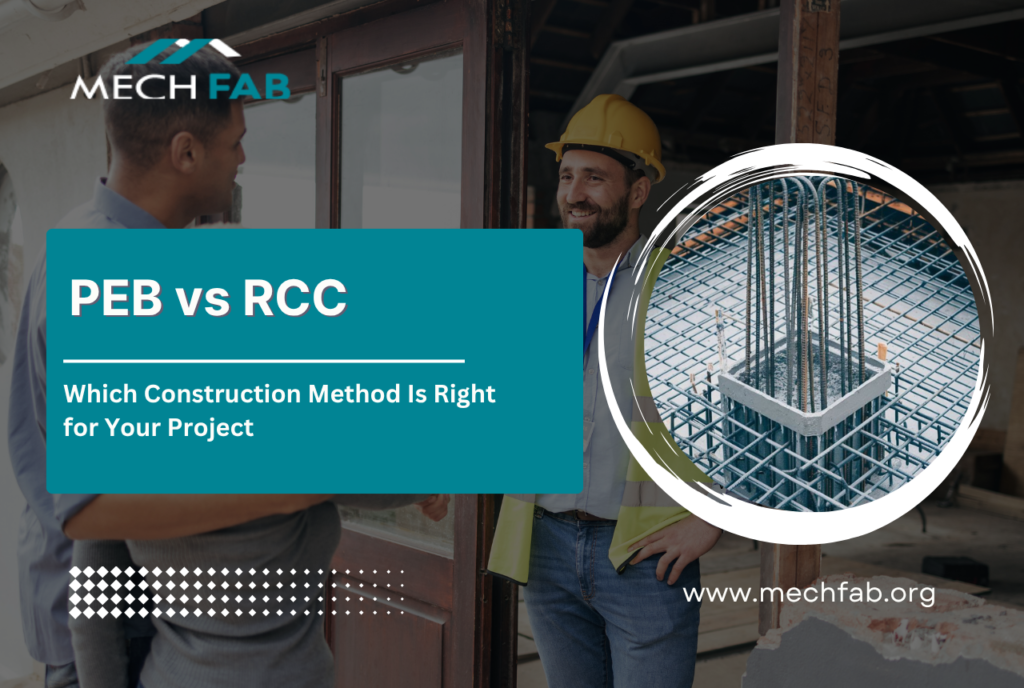
You’re about to build a warehouse, a factory, or a large commercial space — and the first real question hits you: should you go with a Pre-Engineered Building (PEB) or stick with the conventional RCC (Reinforced Cement Concrete) structure?
Get this decision wrong and you’re looking at cost overruns, delays, or a structure that doesn’t suit your use case. Get it right, and you save time, money, and future headaches.
In this guide, we break down PEB vs RCC in simple terms — construction cost, speed, structural strength, best use cases, and more — so you can make a confident, informed decision.
What Is PEB (Pre-Engineered Building)?
A Pre-Engineered Building (PEB) is a steel structure that is designed, fabricated, and partially assembled at a factory before being shipped to the construction site and erected on-site.
Think of it like a LEGO set — every component is precision-engineered and numbered, so assembly on-site is fast, predictable, and quality-controlled.
Key Components of a PEB Structure
- Primary steel framing: main columns and rafters
- Secondary members: purlins, girts, eave struts
- Roof and wall cladding panels (colour-coated metal sheets)
- Doors, windows, ventilators, and accessories
- Pre-designed foundations (lighter than RCC)
What Is RCC (Reinforced Cement Concrete) Construction?
RCC is the traditional building method where a framework of steel reinforcement bars (rebars) is cast inside concrete to create load-bearing structural members — columns, beams, slabs, and walls.
RCC structures are essentially built from scratch on-site using raw materials: cement, sand, aggregate, and steel.
Key Components of an RCC Structure
- Reinforced concrete columns and beams
- Slabs (flat or ribbed) for floors and roofs
- Load-bearing or framed walls
- Deep or raft foundations for heavy loads
- Brick/block masonry infill walls
PEB vs RCC: Why This Comparison Matters
India’s construction sector is growing at a rapid pace, especially in states like Assam where industrial corridors, warehousing hubs, and commercial real estate projects are booming.
Choosing between PEB and RCC isn’t just a technical decision — it directly impacts:
- Your total project budget (often by 20–35%)
- Your timeline (PEB can be 3–4x faster to erect)
- Future scalability of your facility
- Long-term maintenance costs
- Compliance with local building codes and seismic zones
In Northeast India, including Guwahati and Assam, seismic activity (Zone IV/V) makes structural choice even more critical.
PEB vs RCC: Full Side-by-Side Comparison
Here is a comprehensive comparison across the most important decision factors:
| Factor | PEB (Pre-Engineered Building) | RCC (Reinforced Cement Concrete) |
| Construction Speed | 4–12 weeks | 6–18+ months |
| Cost (approx.) | ₹1,500–₹2,500/sq ft | ₹1,800–₹3,500+/sq ft |
| Structural Weight | 30–40% lighter | Heavy |
| Earthquake Resistance | Excellent (flexible) | Good (rigid) |
| Design Flexibility | Moderate | High |
| Column-free Span | Up to 90m possible | Limited (usually <15m) |
| Maintenance | Periodic re-coating | Low over long term |
| Lifespan | 25–50 years | 50–100 years |
| Expandability | Very easy | Difficult |
| Foundation Requirement | Lighter | Heavier/deeper |
| Best For | Warehouses, factories, showrooms | Homes, hospitals, multi-storey |
PEB vs RCC Cost Comparison: What Does Each Really Cost?
Cost is usually the first filter. Let’s break it down realistically.
PEB Construction Cost
- Structure fabrication: ₹800–₹1,400 per sq ft
- Foundation (lighter): ₹150–₹300 per sq ft
- Cladding + accessories: ₹300–₹500 per sq ft
- Typical all-in range: ₹1,500–₹2,500 per sq ft
RCC Construction Cost
- Structure (columns, beams, slabs): ₹900–₹1,500 per sq ft
- Foundation (heavier): ₹250–₹600 per sq ft
- Brickwork, plastering, finishing: ₹400–₹900 per sq ft
- Typical all-in range: ₹1,800–₹3,500+ per sq ft
PEB vs RCC: Construction Speed Comparison
Time is money in industrial construction. Here’s how the two compare on speed:
PEB Timeline
- Design and engineering: 2–4 weeks
- Fabrication at factory: 4–8 weeks
- Foundation work on-site: concurrent with fabrication
- Erection on site: 2–4 weeks
- Total: 8–16 weeks for a medium-sized building
RCC Timeline
- Design: 2–4 weeks
- Site preparation and excavation: 2–4 weeks
- Foundation casting and curing: 4–6 weeks
- Structural frame (columns, beams, slab): 8–20 weeks
- Finishing and MEP work: 4–12 weeks
- Total: 6–18 months depending on size and complexity
The speed advantage of PEB is clear — especially for industrial projects with fast-approaching deadlines or pre-committed tenants.
PEB vs RCC Structural Strength and Durability
A common misconception: ‘PEB is weaker than RCC.’ This is simply not true when the structure is correctly designed and maintained.
PEB Structural Strengths
- Uses high-tensile steel (Grade 250–345 MPa), which is strong yet lightweight
- Excellent performance in seismic zones due to ductility and flexible connections
- Factory-controlled quality ensures consistent structural integrity
- Tapered sections optimise material use — stronger where it’s needed most
RCC Structural Strengths
- Excellent compressive strength — ideal for multi-storey loads
- Fire resistance is naturally higher without added coatings
- Performs well under sustained heavy point loads (machinery, heavy storage)
- Better resistance to corrosion without maintenance
For single-storey industrial buildings, PEB structural performance matches or exceeds RCC. For multi-storey structures or buildings with extremely heavy point loads, RCC may be preferable.
When to Choose PEB: Best Use Cases
PEB is the right choice when you need:
- Speed: Your facility must be operational within 3–6 months
- Large clear spans: Warehouses, aircraft hangars, sports halls needing 30–90m column-free space
- Budget certainty: Fixed-price factory fabrication reduces on-site cost variables
- Future expansion: Bolt-on expansion bays can be added later without major structural work
- Industrial/commercial use: Factories, cold storage, logistics hubs, automobile showrooms
PEB Projects Where MechFab Has Delivered Results
- Industrial warehouses and distribution centres across Assam
- Manufacturing plant structures for Northeast India clients
- Commercial showrooms and retail sheds
- Agricultural storage facilities
When to Choose RCC: Best Use Cases
RCC remains the gold standard for:
- Multi-storey buildings: Apartments, office towers, hospitals where floors stack on each other
- Residential homes: Where customisation, finishes, and long-term living are priorities
- High fire-risk environments: Facilities storing highly flammable materials at scale
- Heavy machinery foundations: Presses, turbines, and equipment generating significant vibration or point loads
- Coastal or corrosive environments: Where steel structures require more frequent protective maintenance
Conclusion
There’s no universal winner in the PEB vs RCC debate. The right choice depends on your building type, budget, timeline, location, and long-term plans.
As a rule of thumb:
- Choose PEB for: single-storey industrial/commercial buildings, tight deadlines, large clear spans, and budget-sensitive projects
- Choose RCC for: multi-storey structures, residential buildings, high fire-risk uses, and projects requiring maximum customisation
If you’re planning a project in Guwahati, Assam, or anywhere across Northeast India — and you want an expert team that has delivered both PEB and steel structures in this region — MechFab is here to help.
FAQ
Q1. Is PEB stronger than RCC?
For single-storey structures, PEB can be equally strong or stronger than RCC — using high-tensile structural steel grades. However, for multi-storey or high-compressive-load applications, RCC’s structural behaviour under sustained loads gives it an advantage. PEB performs particularly well in seismic conditions due to its inherent ductility.
Q2. Which is cheaper — PEB or RCC?
PEB is typically 20–35% cheaper than RCC for single-storey industrial buildings when you account for both construction cost and speed. For small buildings (below 2,000 sq ft) or multi-storey construction, RCC may be more economical. Always compare full lifecycle costs, not just upfront numbers.
Q3. How long does a PEB structure last?
A well-designed and maintained PEB structure typically lasts 25–50 years. With proper anti-corrosion coatings, the lifespan can be extended significantly. RCC structures, when designed correctly, can last 50–100 years. PEB’s shorter lifespan is a trade-off for its lower cost and faster construction.
Q4. Can PEB be used for residential buildings?
Technically yes, but PEB is rarely used for residential construction in India. The limitations in architectural customisation, interior feel, and the availability of skilled RCC construction workers at every location make RCC a far more practical and socially accepted choice for homes. PEB excels in the industrial and commercial sectors.
Q5. Is PEB construction suitable for Assam and Northeast India?
Absolutely. PEB is well-suited to Assam and Northeast India, provided the design accounts for seismic Zone IV/V requirements, heavy annual rainfall (wind and snow loads in hilly areas), and the local soil conditions (which often require special foundation treatment). MechFab has extensive experience engineering PEB structures specifically for Northeast India’s unique climatic and seismic context.
Q6. What is the minimum size for a PEB to be cost-effective?
In general, PEB becomes clearly cost-effective for buildings above 3,000–5,000 sq ft. Below this size, the cost of mobilising PEB fabrication and erection teams may offset savings. For smaller structures, RCC or a hybrid approach may be more practical.