
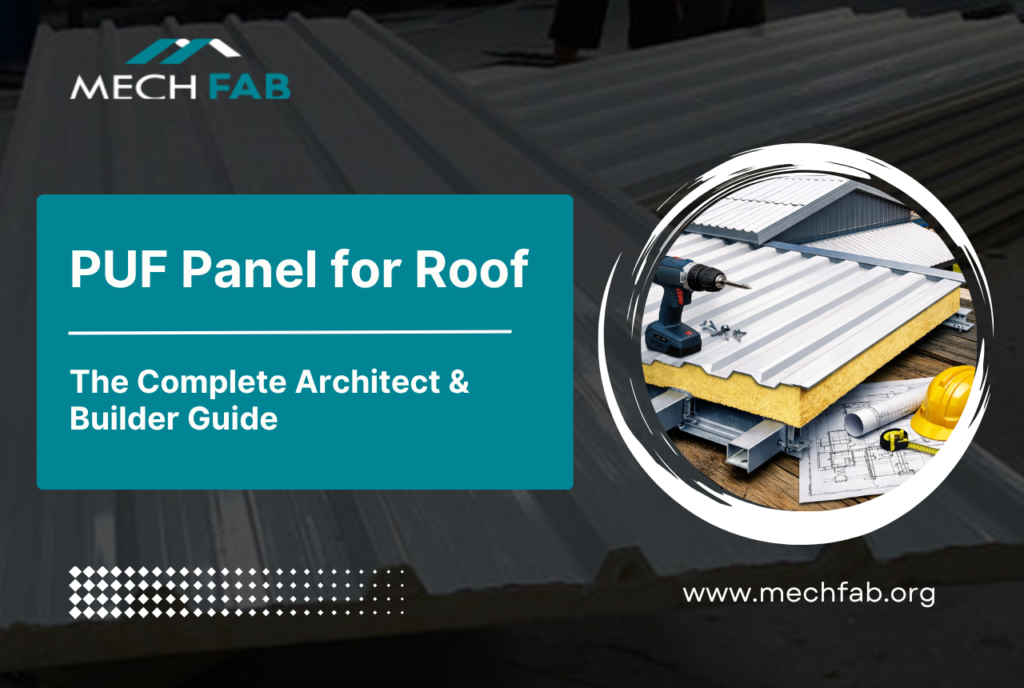
This guide covers everything in one place: what PUF roof panels are, how they’re engineered, which thickness to specify for which project type, how to detail the installation correctly, and what to watch out for. No fluff — just the technical and practical knowledge that helps you make the right call on your next specification.
What Is a PUF Panel for Roof
A PUF (Polyurethane Foam) panel for roof is a factory-fabricated composite element made up of a rigid closed-cell polyurethane foam core bonded — under controlled pressure and heat — between two pre-coated metal facings. The result is a structural, insulating, and weather-resistant roofing unit delivered as a single component to site.
Unlike built-up roofing systems where insulation, structure, and waterproofing are installed in separate trades, a PUF sandwich panel performs all three functions simultaneously. That is the core reason architects and builders have adopted it so rapidly for PEB and pre-fabricated construction across India.
Anatomy of the Sandwich Panel
Understanding the three layers helps you specify correctly and communicate precisely with your fabricator.
| Layer | Typical Material | Thickness Range | Function |
| Outer Facing (Top) | PPGI / PPGL / Galvalume steel | 0.40 mm – 0.60 mm | Weather barrier, UV & corrosion resistance, load transfer |
| Core | Rigid closed-cell PU foam (PUF) or PIR | 30 mm – 200 mm | Thermal insulation, acoustic damping, shear continuity |
| Inner Facing (Bottom) | PPGI / Aluminium / SS-304 | 0.40 mm – 0.50 mm | Interior finish, vapour barrier, corrosion resistance |
The foam core is injected in liquid form between the two metal skins; it expands, self-adheres, and cures to form an inseparable composite. This continuous bonding — rather than mechanical fasteners between layers — is what gives the sandwich panel its composite structural action, allowing thinner elements to span greater distances than their individual components could achieve alone.
Types of PUF Roofing Panels
1. Standard PUF Roof Panel (Trapezoidal Profile)
The most commonly used type. The outer face is roll-formed into a trapezoidal or sinusoidal profile for structural stiffness and efficient rainwater runoff. Typical span ranges from 3 m to 9 m between purlins, depending on gauge and core thickness. Widely used for industrial sheds, warehouses, and PEB structures.
2. Hidden-Fastener (Secret-Fix) Roof Panel
A premium profile where fasteners are concealed beneath panel overlaps, eliminating exposed screw heads. This produces a cleaner, uninterrupted roof plane — popular in commercial buildings, offices, and architectural PEB projects where aesthetics matter. It also eliminates the risk of fastener-related leaks at penetration points.
3. PIR (Polyisocyanurate) Core Roof Panel
PIR foam offers higher fire resistance than standard PUF (PUR) foam and better performance at elevated temperatures. Specified where fire-safety codes are stringent — pharma facilities, food-processing plants, logistics hubs handling flammable goods, and airport structures.
4. Continuous-Line vs. Discontinuous-Line Panels
Continuous-line manufactured panels are produced on automated lines that inject and cure foam in a single uninterrupted pass — delivering consistent foam density (typically 38–42 kg/m³), uniform adhesion, and tighter dimensional tolerances. For critical projects, always ask your supplier whether panels are continuous-line produced.
Thickness Selection Guide
Choosing the right core thickness is the most important specification decision. The table below provides a starting point; always verify with thermal and structural calculations for your specific site, climate zone, and loading conditions.
| Core Thickness | U-Value (Approx.) | Best-Fit Application |
| 30 mm | ~0.75 W/m²K | Temporary structures, site offices, low-thermal-demand sheds |
| 40 mm | ~0.56 W/m²K | General industrial sheds, poultry farms, storage warehouses |
| 50 mm | ~0.45 W/m²K | Commercial buildings, offices, LEED-targeted projects |
| 60–80 mm | ~0.35–0.28 W/m²K | Air-conditioned factories, clean rooms, food processing |
| 100–150 mm | ~0.22–0.15 W/m²K | Cold storage, pharma warehouses, critical temperature-control |
Seven Benefits That Matter to Architects & Builders
- Superior Thermal Performance: Closed-cell PUF achieves R-values up to 7× better than conventional concrete or metal roofing. This directly reduces HVAC sizing and operational energy bills.
- Faster Construction: Panels arrive site-ready and install in a fraction of the time of cast-in-place or built-up roofing. A large warehouse roof can be covered in days, not weeks.
- Lightweight Structure: At 10–18 kg/m² (vs. 240+ kg/m² for RCC), PUF roofing panels dramatically reduce dead loads — allowing lighter primary steel frames and lower foundation costs.
- Acoustic Insulation: The foam core absorbs sound, reducing noise transmission from rain, machinery, and ambient sources — a meaningful benefit for offices and food-processing buildings.
- Structural Composite Action: The bonded sandwich behaves as a composite beam, allowing panels to span further than equivalent-weight metal-only sections — reducing purlin count and steel tonnage.
- Sustainability & Green Ratings: High thermal resistance reduces operational carbon emissions and contributes to GRIHA and LEED credit categories. CFC-free PUF formulations are now standard.
- Design Flexibility: Available in a wide range of RAL colours, profile depths, and both standard and hidden-fix systems — giving architects clean, contemporary rooflines without compromise.
Applications & Project Types
Industrial Warehouses & Logistics Hubs
This is the most common application. Trapezoidal PUF roof panels on PEB frames allow column-free spans of 30–60 m, rapid erection, and compliance with goods-storage temperature requirements — all at a significantly lower project cost than conventional construction.
Cold Storage & Refrigerated Warehouses
Thick-core (80–150 mm) PUF panels are the technical standard for cold-chain facilities. The continuous foam bond eliminates thermal bridges, while PIR variants meet fire-safety codes that apply to refrigerated spaces handling food or pharmaceutical products.
Commercial & Institutional Buildings
Offices, educational institutions, healthcare buildings, and retail developments are increasingly specifying PUF roofing for its combination of thermal control, fast programme delivery, and quality interior finish. The hidden-fix profile suits these building types particularly well.
Clean Rooms & Pharma Facilities
Controlled environments demand sealed, easily cleaned, non-particulate-shedding surfaces. PUF panels with stainless steel or food-grade aluminium inner facings meet GMP requirements. The airtight panel joint systems help maintain the differential pressures clean rooms require.
Agri-Processing & Poultry Infrastructure
Temperature and humidity control directly impacts productivity in poultry and agri-processing. PUF roofing delivers this at a price point and speed that conventional materials cannot match — an important consideration in Northeast India’s expanding agri-sector.
Installation Best Practices
Even the best panel specification delivers poor outcomes if installation is incorrectly executed. The following steps reflect the standard recommended by experienced PEB contractors.
| 1 | Verify Purlin Layout & Centres Confirm purlin spacing matches panel span tables for the specified core thickness and gauge. Overloading spans is the most common cause of panel deflection. |
| 2 | Unload & Store Correctly Stack panels flat on level dunnage, never exceeding 10 panels per stack. Keep protective film intact. Avoid point-loading on the panel face. |
| 3 | Install Ridge to Eave Start at the high point (ridge) and work toward the eave. This ensures overlap joints shed water correctly and prevents moisture tracking back under the panel. |
| 4 | Seal All Joints & Laps Use manufacturer-approved butyl or EPDM foam tape at all side laps and end laps. This is critical in high-rainfall regions such as Northeast India. Unsealed joints are the primary cause of roof leaks in PUF panel installations. |
| 5 | Use Correct Fasteners Specify self-drilling, self-tapping carbon steel or stainless fasteners with EPDM washers. Over-torquing compresses the washer and breaks the seal; under-torquing leaves a gap. Use a calibrated torque driver. |
| 6 | Install Ridge Caps & Flashings Last Ridge caps, barge flashings, and valley trims must be installed with continuous sealant beads and correctly lapped over panel ends. These termination details disproportionately affect long-term weather tightness. |
| 7 | Remove Protective Film Promptly Peel protective polyethylene film from all panels within 48 hours of installation, before UV exposure degrades the adhesive and leaves ghost marks on the paint finish. |
Limitations & How to Mitigate Them
Fire Behaviour of Standard PUF
Standard PUR foam is combustible. Mitigation: Specify fire-retardant (FR) grade PUF panels with a self-extinguishing foam formulation for occupied buildings, or upgrade to PIR-core panels where building codes require Class 1 or Class 0 fire ratings. Always confirm fire ratings are third-party tested, not just claimed.
Joint Waterproofing
Side and end laps between panels are the system’s Achilles heel if installation is not carefully controlled. Mitigation: Specify continuous batten-seal tapes, ensure contractor training, and conduct a post-installation roof inspection before handover.
Coastal & High-Humidity Environments
Salt-laden air accelerates corrosion of cut edges and exposed metal. Mitigation: Specify panels with a higher zinc-coating mass (AZ150 or AZ185 Galvalume) for coastal sites. Ensure all cut edges receive a corrosion-inhibiting touch-up coat on site.
Design Rigidity
Panels are manufactured to standard widths (typically 1,000 mm or 1,100 mm) and cannot be curved in the field. Mitigation: For curved rooflines, use factory-crimped panels or integrate polycarbonate or metal coping elements at the transition zones.
Conclusion
The PUF panel for roof has earned its dominant position in Indian construction for a straightforward reason: it solves multiple problems — insulation, structure, weight, speed, and aesthetics — in a single manufactured element. For architects and builders working on industrial, commercial, or institutional projects, it remains the most technically coherent and economically compelling roofing specification available.
The decisions that matter most are selecting the right core thickness for your thermal and structural requirements, specifying the correct fire grade for occupancy category, and ensuring installation is carried out by a contractor experienced in PUF panel detailing — particularly at joints, ridges, and penetrations.
Mechfab Engineering Industries has been designing and delivering Pre-Engineered Buildings with integrated PUF panel roofing systems across Northeast India since 1978. If you’re working on a project where performance, speed, and long-term reliability matter, we’d be glad to support your specification.
Frequently Asked Questions
Q What is a PUF panel for roof?
A PUF (Polyurethane Foam) roofing panel is a sandwich composite: a rigid closed-cell PUF core bonded between two pre-painted steel sheets. It provides simultaneous structural, thermal, acoustic, and waterproofing functions in a single factory-finished element.
Q What thickness of PUF roofing panel should I specify?
For standard industrial or commercial roofing in India, 40–60 mm PUF thickness is sufficient. For cold-storage, pharma, or extreme-climate applications, 80–120 mm is recommended. Always verify thermal and structural calculations with your PEB supplier before finalising the specification.
Q How long do PUF roof panels last?
With correct installation, annual inspection, and routine maintenance (cleaning gutters, re-sealing flashings as needed), high-quality PUF roof panels typically deliver a service life of 20–25 years or more.
Q Are PUF roof panels fire-safe?
Standard PUF is combustible. Fire-retardant grade PUF panels with self-extinguishing foam, or PIR-core panels, are available and recommended for occupied buildings. Always ask for third-party fire test certificates — not just a manufacturer’s claim.
Q What is the price of PUF roofing panels in India?
Prices vary by thickness, facing material, coating grade, and order volume. Galvanised steel PUF roof panels broadly range from ₹1,000 to ₹2,000 per sqm. Contact Mechfab for a detailed, project-specific quotation.
Q Can PUF roof panels be used in Northeast India’s high-rainfall zone?
Yes — and they are widely used across Assam, Meghalaya, Manipur, and the broader Northeast. The key is correct installation: full sealant taping at all laps, proper slope (minimum 5° pitch), and correctly detailed ridge and eave flashings. Mechfab has been delivering PEB and PUF panel projects across the Northeast since 1978.