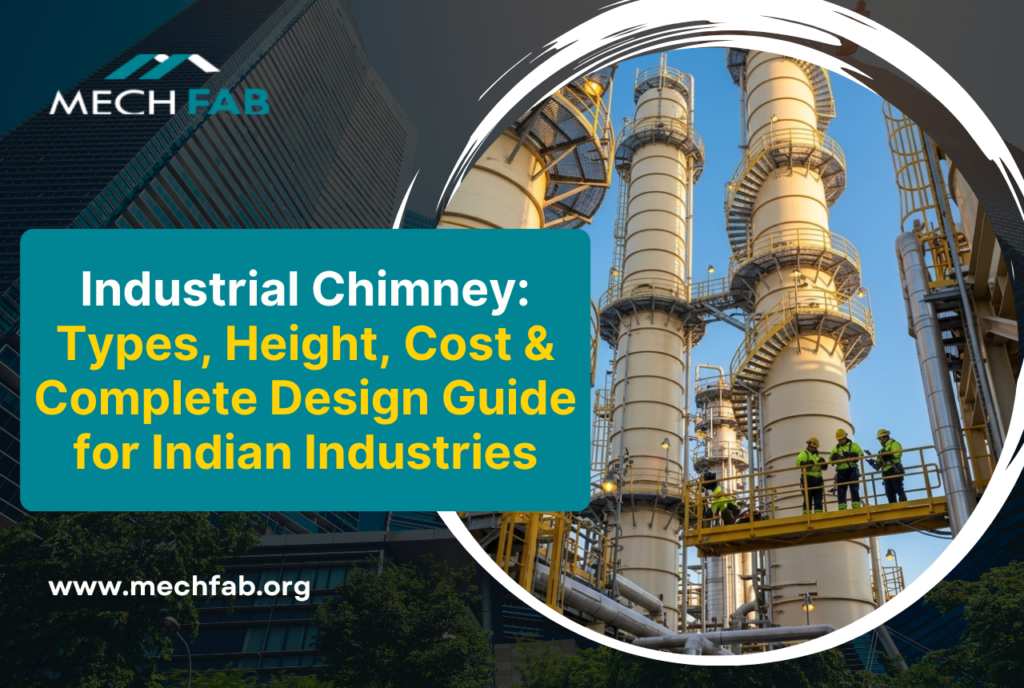
Every factory you see with a towering steel or concrete structure rising into the sky tells a story of engineering precision. That structure is an industrial chimney — and it does far more than just release smoke.
Whether you are setting up a new manufacturing facility, a boiler plant, or a power station, choosing the right industrial chimney is one of the most critical decisions you will make. Get it wrong, and you face pollution compliance issues, structural failures, or massive operational losses. Get it right, and your plant runs efficiently, safely, and legally for decades.
This guide covers everything you need to know — from types and height requirements to pricing and design considerations. If you are planning infrastructure for your plant or pre-engineered building, this article is for you.
What Is an Industrial Chimney?
Industrial chimneys are required to carry vertically and discharge gaseous products of combustion, chemical waste gases, and exhaust air from industry to the atmosphere. In simpler terms, they are tall structures engineered to safely vent harmful gases away from ground level, protecting workers, communities, and the surrounding environment.
Chimneys are tall and slender structures used to discharge waste or flue gases at higher elevation with sufficient exit velocity such that gases and suspended particles disperse safely into the atmosphere.
Their role is twofold: creating the draft necessary to pull gases out of combustion chambers, and releasing those gases high enough that ground-level concentrations remain within regulatory limits set by pollution control authorities.
Types of Industrial Chimneys
Choosing the right type of industrial chimney depends on your industry, gas composition, temperature, and budget. Industrial chimneys are classified based on the number of flues, material of construction, structural support, and whether or not they have a lining. Here is a practical breakdown:
1. Steel (MS) Chimneys
Steel chimneys are the most widely used in Indian industrial facilities. Steel chimneys include self-supporting chimneys made of steel plates on a foundation, and guyed chimneys which use wire ropes to help support taller structures.
Steel chimneys are ideally suited for process work where a short heat-up period and low thermal capacity are required, and are also economical for heights up to 45 metres. They are the go-to choice for boiler plants, DG sets, and small to medium-scale industrial units.
2. Reinforced Concrete (RCC) Chimneys
RCC chimneys are preferred for large-scale industries like power plants, cement factories, and refineries. Concrete block chimneys are typically used in industrial applications and allow for taller structures. The chimney can be customised for a single or multiple stack without being limited to a strictly rectangular design.
These chimneys are designed to withstand extreme temperature loads, wind pressure, and seismic forces. Design codes such as IS: 4998 govern their construction across India.
3. FRP (Fibre Reinforced Plastic) Chimneys
FRP chimneys are corrosion-resistant and lightweight. They are ideal for chemical plants, fertiliser units, and industries dealing with acidic gases. While not suitable for very high temperatures, they are cost-effective and low-maintenance for specific applications.
4. Brick Chimneys
Traditional brick chimneys are largely being replaced by steel and RCC variants due to their higher construction time and limited design flexibility. However, they still appear in older industrial setups and heritage facilities.
How Tall Are Industrial Chimneys?
This is one of the most common questions plant engineers ask. The height of the chimney is governed by gas plume dispersion at the top. The height should ensure required draft and exit velocity of flue gases such that the ground-level concentration of pollutants, after atmospheric dispersion, is within the limits prescribed by local pollution regulatory standards.
In practice:
- Small industrial units and DG sets: 10 to 30 metres
- Medium boiler plants and factories: 30 to 60 metres
- Large power plants and cement industries: Chimneys of 50 to 100 metres are very commonly used
- Thermal power stations: Can go up to 220 metres or more
The taller the chimney, the better the dispersion — but also the higher the structural and cost demands. A qualified structural engineer must calculate the exact height based on flue gas volume, temperature, local wind speeds, terrain category, and pollution control norms in your region.
What Makes Industrial Chimney Design Complex?
Industrial chimney design is not a simple sizing exercise. The design and dimensioning of these structures are of crucial importance to ensure optimal operation of industrial plants. Key parameters such as air velocity, pressures, temperatures and pollutant concentrations must be analyzed accurately.
Engineers must account for:
Thermal Loads: The inside surface is at flue gas temperature while the outside is at atmospheric temperature. This differential can vary significantly, and if the temperature difference is very high, internal lining is required to flatten the temperature gradient.
Wind and Seismic Forces: India’s different terrain zones have varying wind speeds. A chimney in Northeast India, for example, must be engineered for local wind patterns as well as seismic zone requirements.
Chimney Sizing: The chimney’s main function is to act as a smoke extractor. Thanks to its height, it creates a vacuum that extracts combustion fumes from the combustion chamber. Its second role is to discharge fumes and dissipate them by raising them as high as possible to promote their dispersion and reduce their environmental impact.
Lining Requirements: When the temperature gradient exceeds 40°C, lining is required to reduce thermal stresses in concrete and steel. Common lining materials include acid-resistant bricks, acid-resistant fire bricks, and mild steel liners.
Industrial Chimney Price in India
One of the biggest concerns for any plant manager or project developer is cost. Industrial chimney prices in India vary considerably based on material, height, diameter, and site-specific requirements.
Here is a general price reference:
| Type | Approximate Price Range (INR) |
|---|---|
| MS/Mild Steel Chimney (small, up to 15m) | ₹13,000 – ₹1,00,000 |
| MS Chimney (30–50 feet, medium) | ₹2,50,000 – ₹4,50,000 |
| FRP Industrial Chimney | ₹1,50,000 – ₹5,00,000+ |
| RCC Chimney (large, custom) | ₹10,00,000 and above |
| Custom Fabricated Steel Chimney | ₹80–₹140 per kg (fabrication cost) |
Prices vary based on your location, the fabricator’s experience, surface treatment requirements (like shot blasting and painting), and add-ons such as aviation lights, monkey ladders, lightning arrestors, and earthing systems.
When comparing quotes, always check whether the price includes foundation design, erection, statutory compliance documentation, and post-installation support.
Chimney Designed for Large-Scale Industries: Key Considerations
Large-scale industrial chimneys are engineering projects in themselves. If your facility is a thermal power plant, steel mill, cement factory, or a large chemical processing unit, here are the factors that matter most:
Multi-Flue Design: Large plants often run multiple boilers. A multi-flue chimney allows several boiler connections within a single concrete windshield structure, reducing footprint and civil costs while improving operational efficiency.
Advanced Lining Systems: Modern industrial chimney designs use linings that are completely acid-resistant without limitations for temperature or concentration, and are better suited for seismic regions. The elimination of an internal flue leads to a great reduction in mass, which is favourable when designing chimneys for seismic conditions.
Regulatory Compliance: Any chimney for large-scale industry must comply with the Central Pollution Control Board (CPCB) norms and state pollution control authority requirements. Stack height calculations must be submitted along with Environmental Clearance documentation.
Structural Integration with Your Building: If your plant uses a pre-engineered building (PEB) structure, the chimney must be carefully coordinated with the overall structural layout, load paths, and foundation design. This is where working with an experienced steel fabricator makes all the difference.
Why Choose a Specialist Fabricator for Your Industrial Chimney?
An industrial chimney is not a commodity product you order off a shelf. It requires precision engineering, quality material, proper structural analysis, and compliance with Indian Standards like IS: 6533 (for steel chimneys) and IS: 4998 (for RCC chimneys).
At Mechfab, we bring the same precision and reliability that defines our Pre-Engineered Buildings and steel fabrication projects to every industrial chimney we design and build. Our team understands the structural, thermal, and regulatory demands of industrial chimney construction — and we deliver solutions that are built to last.
Whether you need a simple DG exhaust stack or a custom-engineered multi-flue chimney for a large industrial plant, our in-house fabrication capabilities ensure tight tolerances, quality welds, and on-time delivery. Just as our pre-engineered buildings are known for being modern, durable, and efficient, our chimney solutions follow the same standard of excellence.
You can also learn more about industrial steel structures and pre-engineered buildings that integrate seamlessly with chimney systems in large industrial setups.
For further technical reading on chimney sizing standards and pollution norms, the Central Pollution Control Board’s guidelines are an excellent reference for plant engineers and project developers in India.
Maintenance: Keeping Your Industrial Chimney Safe
A chimney that is not regularly inspected can become a liability. Common issues include:
- Corrosion of steel sections, especially at the base where condensate collects
- Cracks in RCC structures due to thermal cycling
- Deterioration of linings from acidic flue gases
- Lightning protection system failures
- Loose or corroded guy wires in guyed chimneys
Routine inspection every 12 to 24 months, combined with protective coatings and timely repairs, significantly extends chimney lifespan and keeps your facility compliant.
Conclusion: The Right Chimney Is a Long-Term Asset
An industrial chimney is not just an exhaust outlet — it is a critical piece of infrastructure that impacts your plant’s safety, compliance, and operational continuity. Whether you are choosing between steel and RCC, calculating the right height, or budgeting for a large-scale chimney project, getting the fundamentals right from the start saves you significant cost and compliance risk in the long run.
At Mechfab, we combine deep fabrication expertise with a commitment to modern, durable, and efficient industrial structures — from Pre-Engineered Buildings to custom chimney systems. If you are planning a new project or upgrading an existing chimney, reach out to our team today for a consultation.
Ready to build a chimney that meets every standard? Contact Mechfab and let our engineering team design the right solution for your industry.
Frequently Asked Questions (FAQ)
Q1. What is an industrial chimney used for?
An industrial chimney is used to safely discharge harmful combustion gases, chemical waste gases, and exhaust air from manufacturing plants, boilers, power stations, and other industrial facilities into the upper atmosphere, ensuring ground-level pollution remains within regulatory limits.
Q2. Which type of industrial chimney is best for small factories?
For small factories and DG exhaust applications, mild steel (MS) chimneys are the most practical and cost-effective option. They are easy to fabricate, install quickly, and are economical for heights up to approximately 45 metres.
Q3. How tall should an industrial chimney be?
The required height depends on the volume and temperature of flue gases, terrain category, local wind conditions, and pollution control norms. Smaller units typically require 10–30 metre chimneys, while large power plants may need chimneys exceeding 100 metres. A qualified engineer must calculate the precise height based on your specific process data.
Q4. What is the price of an industrial chimney in India?
Prices vary widely based on material, height, and design complexity. A small MS chimney can cost from ₹13,000 to ₹1,00,000, while larger custom-fabricated chimneys for industrial plants can range from ₹2,50,000 to ₹10,00,000 or more, depending on specifications.
Q5. What Indian standards govern industrial chimney design?
Steel chimneys in India are governed by IS: 6533, while RCC chimneys follow IS: 4998. Additional applicable codes include IS: 875 (wind loads), IS: 1893 (seismic design), and CPCB guidelines for stack height and emission norms.
Q6. Can an industrial chimney be integrated with a pre-engineered building?
Yes. With proper structural coordination during the design phase, an industrial chimney can be effectively integrated with a pre-engineered building layout. Specialists like Mechfab, who handle both PEB structures and steel fabrication, are best placed to manage this integration seamlessly.
Q7. How often should an industrial chimney be inspected?
Industrial chimneys should be professionally inspected at least once every 12 to 24 months, or after any significant seismic event or extreme weather. Regular inspection covers structural integrity, lining condition, corrosion assessment, lightning protection, and compliance with emission standards.