
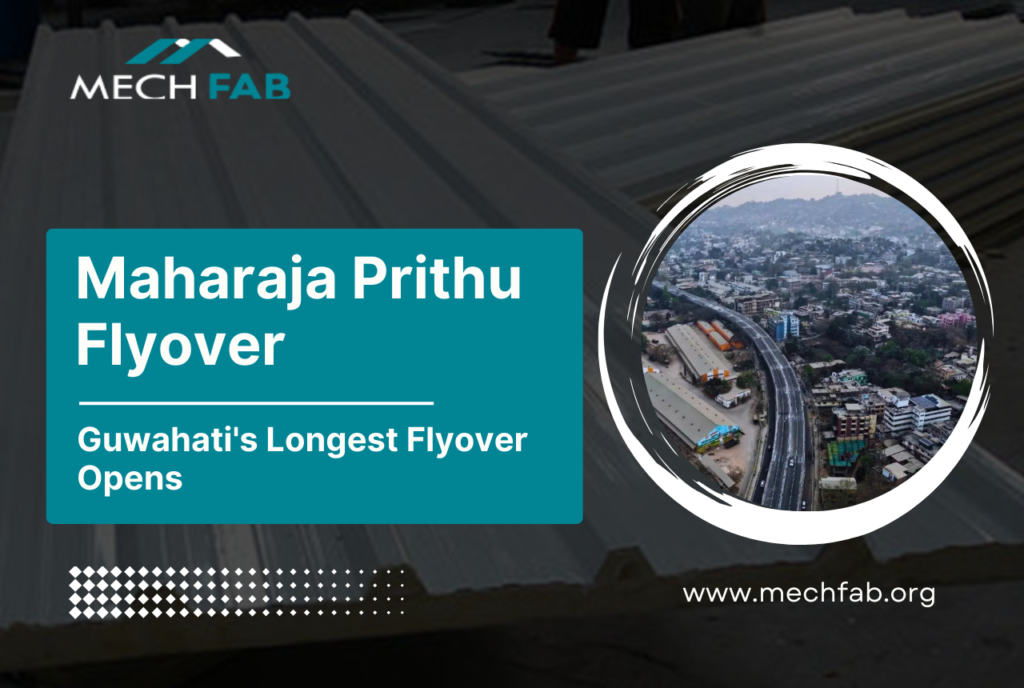
Meta Description: Guwahati’s Maharaja Prithu Flyover — Assam’s longest flyover at 4.5 km — opened in March 2026. Discover its cost, route, construction details, historical significance, and what it means for the city’s future.
Introduction: A New Chapter in Guwahati’s Urban Story
Guwahati has witnessed a landmark moment in its urban development journey. On March 10, 2026, Chief Minister Himanta Biswa Sarma inaugurated the Maharaja Prithu Flyover — Assam’s longest flyover to date — marking a transformative milestone for the city’s infrastructure and connectivity.
Built at a total cost of over Rs 800 crore, this 4.5 km elevated corridor stretches across some of Guwahati’s most traffic-heavy zones, offering long-awaited relief to commuters who have battled gridlock for years. If you’ve been searching for everything about the Maharaja Prithu Flyover — when it was built, what materials were used, its route, or its significance — this guide covers it all.
| 📌 Quick Fact The Maharaja Prithu Flyover is 4.5 km long, cost over Rs 800 crore, and connects Noonmati to the Dighalipukhuri area — making it Assam’s longest flyover as of 2026. |
What Is the Maharaja Prithu Flyover?
The Maharaja Prithu Flyover is a multi-arm elevated road project in Guwahati, Assam, designed to ease chronic traffic congestion across the city’s central corridors. It forms a continuous elevated pathway linking key localities — significantly reducing travel time between Noonmati, Chandmari, and Dighalipukhuri.
Officially open: 4.2 km out of the full 4.5 km structure has been opened to public use. Two additional arms — one connecting Rajgarh over the railway line and another linking Guwahati Club Rotary to Kamrup Academy and Uzanbazar — are still under construction.
Walking access first: Before vehicle traffic was permitted (from March 14, 2026), residents were invited to experience sections of the flyover on foot for three days — a first for any flyover inauguration in Assam.
Maharaja Prithu Flyover Route: Which Areas Does It Connect?
The flyover serves as a spine through Guwahati’s core, bridging localities that were previously separated by heavy traffic bottlenecks. Here’s the key connectivity it provides:
- Noonmati ↔ Chandmari (main elevated corridor)
- Chandmari ↔ Dighalipukhuri area
- Chandmari ↔ Guwahati Club Rotary (pedestrian access during inauguration phase)
- Upcoming: Rajgarh (over the railway line)
- Upcoming: Guwahati Club Rotary ↔ Kamrup Academy ↔ Uzanbazar
The existing Chandmari flyover continues to operate alongside the new structure, ensuring no disruption to existing traffic flow during the transition period.
How Much Did the Maharaja Prithu Flyover Cost — and When Was It Built?
Project Cost
The total project cost exceeds Rs 800 crore, making it one of the most significant infrastructure investments in Assam’s urban development history. The funding reflects the state government’s long-term commitment to solving Guwahati’s perennial traffic woes.
Construction Timeline
The flyover was in planning and construction phases over multiple years before its inauguration in March 2026. The phased construction allowed the city to continue functioning with minimal disruption to existing traffic routes, with the Chandmari flyover remaining operational throughout.
Project Length & Scale
- Total planned length: 4.5 km
- Length opened to traffic (March 2026): 4.2 km
- Remaining arms: Under construction (Rajgarh + Uzanbazar extensions)
- Total cost: Over Rs 800 crore
What Steel and Materials Go Into a Flyover Like This?
A flyover of this scale is not built with a single type of steel — it’s a carefully engineered combination of multiple steel products, each selected for a specific structural role. Here’s a breakdown of the key steel components that go into a modern urban flyover in India:
| Steel Component | Specification / Grade | Role in Flyover |
| Structural Steel (Girders & Beams) | High-tensile Fe 500 / Fe 550 grade steel | Spans long distances, bears live load of traffic |
| Reinforcement Bars (Rebar) | TMT (Thermo-Mechanically Treated) bars | Embedded in concrete piers and deck slabs |
| Prestressed Steel Strands | High-strength steel wire/strand | PSC beams for wide flyover spans |
| Expansion Joints (Steel) | Modular steel expansion joints | Allows for thermal movement & vibration |
| Steel Crash Barriers | W-beam / Thrie-beam galvanised steel | Safety guardrails along flyover edges |
| Bearing Plates | Pot-PTFE elastomeric + steel bearings | Supports superstructure on piers |
In a project of this magnitude — 4.5 km, multiple arms, spanning railway lines and high-traffic junctions — the volume of steel involved runs into thousands of metric tonnes. Structural steel procurement, fabrication precision, and quality control are what separate a sound flyover from a compromised one.
Why Is It Named ‘Maharaja Prithu’?
The naming of this flyover is rooted in Assam’s deep historical heritage. Maharaja Prithu was a ruler celebrated as a symbol of resistance and courage — values that the Assam state government chose to honour by linking his legacy to this modern piece of infrastructure.
Chief Minister Himanta Biswa Sarma explained the naming as part of the broader national philosophy of “Vikas bhi, Virasat bhi” — a guiding principle championed by Prime Minister Narendra Modi that advocates for development alongside the preservation of cultural heritage.
“As we modernise our infrastructure, we must also honour the historical figures who shaped our identity,”— CM Himanta Biswa Sarma
How Will It Impact Guwahati’s Traffic and Commuters?
The Maharaja Prithu Flyover addresses one of Guwahati’s most chronic urban challenges: traffic congestion in the Noonmati–Chandmari–Dighalipukhuri belt. The benefits for daily commuters include:
- Dramatically reduced travel time between Noonmati and Chandmari
- Decongestion of ground-level roads prone to bottlenecks at peak hours
- Improved north-south connectivity across the city’s central spine
- A dedicated elevated corridor that bypasses crowded intersections
- Future integration with the Ulubari and Stadium flyovers for a seamless traffic corridor
Beyond daily commuters, the flyover is expected to boost economic activity along the corridor, improve emergency vehicle access, and strengthen Guwahati’s positioning as a smart, well-connected urban centre.
What’s Next? Guwahati’s Expanding Flyover Network
The Maharaja Prithu Flyover is just one piece of a much larger infrastructure puzzle. The state government has outlined ambitious plans for Guwahati’s flyover network:
- Cycle Factory flyover in Guwahati — expected completion before Bihu 2026
- Mission Chariali flyover in Tezpur — likely completion by July 2026
- Two flyovers already completed in Dibrugarh; three more under construction
- Maniram Dewan–Piyoli Baruah flyover — inaugurated March 11, 2026
- Future vision: connecting Ulubari flyover + Guwahati Club flyover + Stadium flyover into one seamless corridor
The Chief Minister also announced that once the ring road project is completed, Guwahati will move toward implementing a metro rail system — signalling the city’s long-term vision for multimodal urban transport.
Conclusion: Guwahati’s Infrastructure Is on the Move
The Maharaja Prithu Flyover is more than a road — it’s a statement. It represents Guwahati’s commitment to becoming a truly modern, connected, and aspirational urban centre without losing sight of its cultural roots. With Assam’s longest flyover now operational and a pipeline of more infrastructure projects underway, the city’s transformation is well and truly underway.
Whether you’re a daily commuter, a business owner along the corridor, or simply a proud resident of Guwahati, the Maharaja Prithu Flyover marks a turning point in how the city moves — and what it aspires to become.
Frequently Asked Questions (FAQ)
Q: When was the Maharaja Prithu Flyover inaugurated?
The Maharaja Prithu Flyover was officially inaugurated on March 10, 2026, by Assam Chief Minister Himanta Biswa Sarma. Vehicular traffic was permitted from March 14, 2026.
Q: How long is the Maharaja Prithu Flyover?
The flyover spans 4.5 km in total. As of inauguration, 4.2 km has been opened for use. The remaining arms connecting Rajgarh and Uzanbazar are still under construction.
Q: How much did the flyover cost?
The flyover was built at a cost of over Rs 800 crore, making it one of the largest single urban infrastructure investments in Assam’s history.
Q: Which areas does the flyover connect?
The flyover primarily connects Noonmati, Chandmari, and the Dighalipukhuri area. Future arms will extend to Rajgarh, Uzanbazar, and the Guwahati Club Rotary.
Q: Who was Maharaja Prithu?
Maharaja Prithu was a historical ruler of Assam, revered as a symbol of resistance and courage. The flyover was named in his honour to celebrate Assam’s rich cultural and royal heritage.
Q: Were any trees cut down for the flyover?
Yes — 70 trees were removed during construction. However, 68 of those were successfully transplanted to the Textile Institute campus, as confirmed by CM Sarma at the inauguration.